One of the first things founders usually do when the business becomes too much to handle alone is to hire a manager.
There are more people to manage.
More customers to deal with.
Many things are happening at the same time.
The founder cannot remain involved in every small business decision.
So the decision is made to hire a manager.
The expectation is that hiring a manager will reduce founder dependency and allow more decisions to move away from the founder.
But very often, that is not what happens.
The manager joins.
The team starts reporting to the manager.
The organisation chart looks better.
But when something important happens, the same question still comes up:
“Should we check with the founder?”
A customer wants something unusual.
There is a pricing issue.
Someone needs approval.
A project is delayed.
Two teams disagree on what should happen next.
The manager may discuss it, coordinate it, even recommend what should be done.
But the final decision still goes back to the founder.
And after some time, the founder begins to think:
Why did I hire a manager if I still have to decide everything?
Want more SME cases like this?
Follow the COSMOS Case Library on YouTube.
***
It is easy at that point to conclude that the manager is not taking ownership.
Sometimes that may even be true.
But not always.
Because in many SMEs, the manager has been given the position and the responsibility, but not what is actually required to run that part of the business.
They may not know the thinking behind earlier decisions.
They may not know how far they can go without approval.
They may not have access to all the information the founder carries in their head.
And when an exception appears, nobody has clearly defined whether the manager should decide, inform, or escalate.
So naturally, the quest to get the solution to the problem at hand travels upward to the founder where the expectation of the answer lies. The result is that the founder continues to remain involved, even though a manager has been hired specifically to deal with these issues.
A manager can hold the title and still not hold the role.
The founder dependency begins to reduce only when the manager can carry not just the work, but enough of the judgment, authority, information and responsibility that previously sat with the founder.
COSMOS OPERATIONAL PATTERN
The Manager Mirage
On paper, the change looks significant.
There is now someone between the founder and the team.
Someone who can coordinate the work.
Someone who can take responsibility.
Someone who should reduce the number of things that come back to the founder.But then the real work begins.
A customer exception comes up.
The manager checks with the founder.
A pricing decision is needed.The manager checks again.
A team issue becomes sensitive.
The founder is brought in.Something unusual happens.
“Let us ask the founder.”The manager is there.
But the founder dependency is still there too.That is The Manager Mirage.
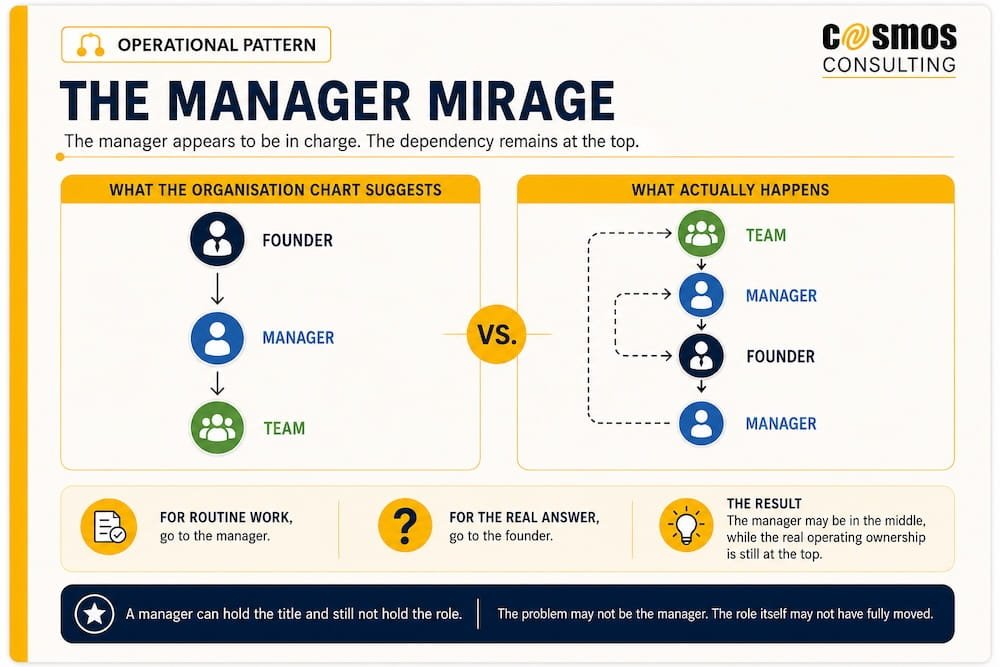
The organisation chart suggests that management capacity has been added.
But if the important decisions, operating context, exceptions, and final judgment still sit with the founder, the business has mainly added another person into the communication flow.
The manager receives questions from the team.
Carries some of them upward.
Gets the decision.
And carries the answer back.
So from the founder’s point of view, it can feel as though the manager is not taking ownership.
From the manager’s point of view, it may feel as though the role still needs the founder in order to function.
And from the team’s point of view, the message becomes clear very quickly:
For routine work, go to the manager.
For the real answer, go to the founder.
That is why hiring a manager does not automatically reduce founder dependency.
The manager may be in the middle,
while the real operating ownership is still at the top.
The Role Has Moved. The Operating Control Has Not.
Why does this happen?
Because hiring a manager changes the organisation chart faster than it changes the way decisions actually move.
The manager may have the responsibility.
But some very important parts of the role may still be sitting with the founder.
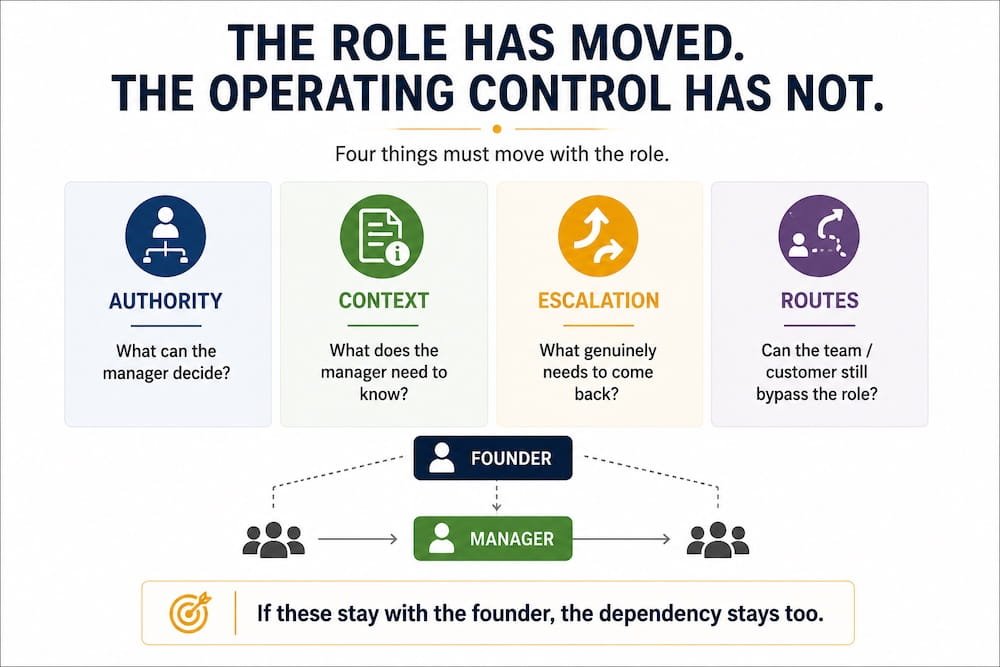
1. The authority has not fully moved
The manager may be responsible for the outcome, but still be unsure about what they can decide on their own.
Can they approve a discount?
Can they change a delivery date?
Can they resolve a customer issue?
Can they move resources?
If the boundaries are unclear, the manager will naturally come back to the founder.
2. The context has not fully moved
The founder may say:
“You decide.”
But the manager may not know what sits behind that decision.
There may be customer history, old commitments, commercial sensitivities, past mistakes, or simply years of experience that have never been shared.
The founder is deciding with context.
The manager may only be seeing the current issue.
So even when authority has technically been given, the manager may not yet feel equipped to use it.
3. The escalation boundary is not clear
Not every decision should move away from the founder.
Some things genuinely need to come back.
But the manager should know which ones.
What can they decide?
What should they inform the founder about?
What genuinely requires escalation?
If that line is not clear, either everything comes back to the founder, or something important does not.
4. The old routes may still be open
The founder may still speak directly to the team.
The team may still message the founder when they want a quick answer.
A priority may still be changed without the manager knowing.
A customer may still call the founder directly.
It is often just the old way of working continuing even after the new role has been created.
***
None of this may be intentional. But every time it happens, it weakens the manager’s authority and sends a very clear message to the team, customers and others:
The manager is responsible, but the founder is still the real point of authority.
That is why simply hiring the person is not enough.
The role has to move too.
Responsibility can be assigned.
Ownership has to be designed.
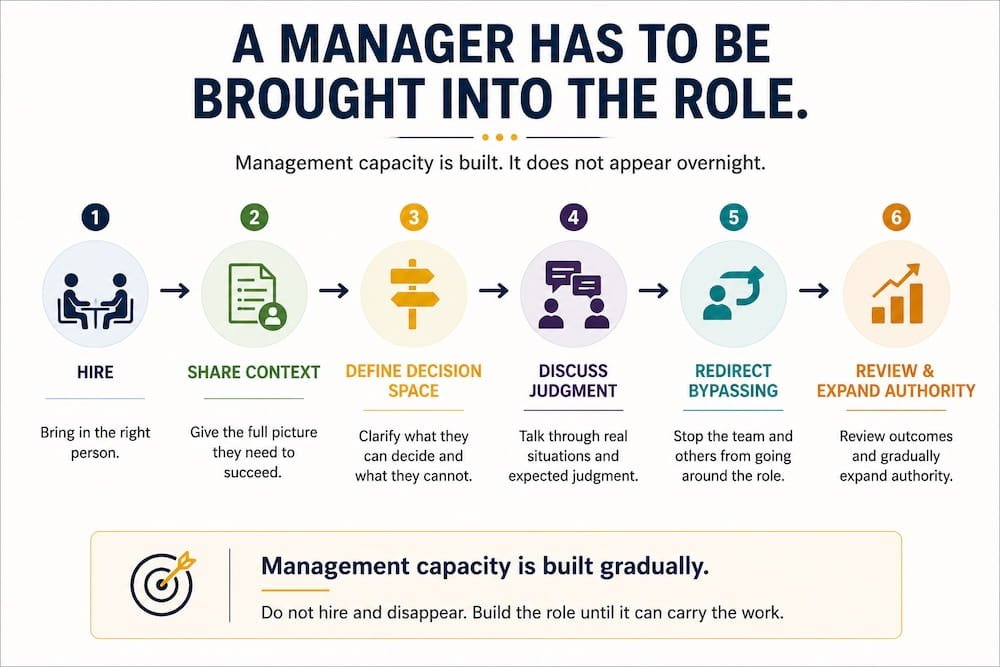
The Manager Has to Be Brought Into the Role
Hiring the manager is only the beginning.
If he is expected to gradually take work load and decisions away from the founder, they need to be brought into the role properly.
Just giving a designation, introducing to the team, and left to figure things out by himself, will lead no where.
1. Start with context, not just a job description
The manager needs to be made to understand how the part of the business he is being assigned to actually works.
Who are the important customers?
Where are the sensitive relationships?
What commitments have already been made?
What problems keep repeating?
Which team members can handle what?
Where does the founder normally become involved, and why?
A lot of this may never have been written down because the founder has simply learned it over the years.
That knowledge now needs to start moving.
This will not happen all at once. But these questions need to be answered as new responsibilities, customers or relationships are handed over to the manager.
2. Define the decision space together
Do not simply tell the manager:
“You can decide.”
This leaves space for ambiguity.
Both the founder and manager need to work together through real situations.
What can he decide without asking?
What should he decide and then inform the founder about?
What genuinely needs to come back to the founder?
And where are the limits?
These boundaries will probably not be perfect on Day 1.
But they become clearer as the founder and manager work through actual situations together.
3. Let the manager think before giving the answer
In the beginning, the manager will come back with questions.
That is absolutely normal.
But instead of immediately giving the answer, the founder can ask:
“What do you think we should do?”
Let the manager explain the decision they would make and why.
Then discuss it.
That is how judgment starts transferring.
If the founder gives the answer every time, the manager learns the answer.
If the founder discusses the thinking behind the answer, the manager gradually learns how to make the next decision.
This also gives the founder confidence in the manager’s capability. They begin to see what the manager can handle, where support is still needed, and what genuinely needs to come back.
4. Stay available, but stop becoming the shortcut
The founder does not have to disappear.
But when team members continue coming directly to the founder for matters the manager now owns, those questions should gradually be redirected to the manager.
Otherwise the team learns that the old route is still open.
The same rule applies for the customers, vendors and others as well.
The manager cannot build authority if everyone knows they can bypass the role whenever they want a faster answer. This also affects the confidence of the manager in his role in the business.
5. Review the manager. Do not approve every move.
Initially, regular discussions are useful and necessary too.
What decisions were made?
Where did the manager hesitate?
What exceptions came up?
What information was missing?
What went wrong?
What went well?
But the purpose of that review should be to build the manager’s judgment, not create another approval stage.
Over time, fewer decisions should need discussion.
And the discussions that remain should become more about exceptions, risks, and larger business judgment.
6. Expand the role as judgment grows
Building management capacity is a gradual process.
As the manager understands the business better and demonstrates sound judgment, the founder can widen the decision space.
More decisions stay with the manager.
Fewer things travel upward
And eventually, the founder is no longer needed simply because something is unfamiliar.
They are involved because the situation genuinely requires their level of judgment.
The answer is not to hire a manager and step away.
It is to help the manager grow into a role that eventually does not need you for every decision.
The COSMOS Perspective
From a COSMOS point of view, this is mainly a Structure problem.
The manager may have the title and the responsibility, but if ownership, decision boundaries and escalation are still unclear, the role is not fully operational.
That is where the COSMOS 4S Systems Framework™ comes in.
Structure defines who owns what, what the manager can decide, and what still needs to move upward.
Systems make the information needed for those decisions visible, so the manager does not have to keep returning to the founder simply because the context sits elsewhere.
There is also a leadership rhythm around the role.
The founder should still review important decisions, exceptions and risks, especially while the manager is growing into the position.
But that review should help build judgment.
It should not become another approval step.
The goal is not to remove the founder from management.
It is to stop the founder from being the operating system behind the manager.
The Real Shift Is From Manager Title to Manager Ownership
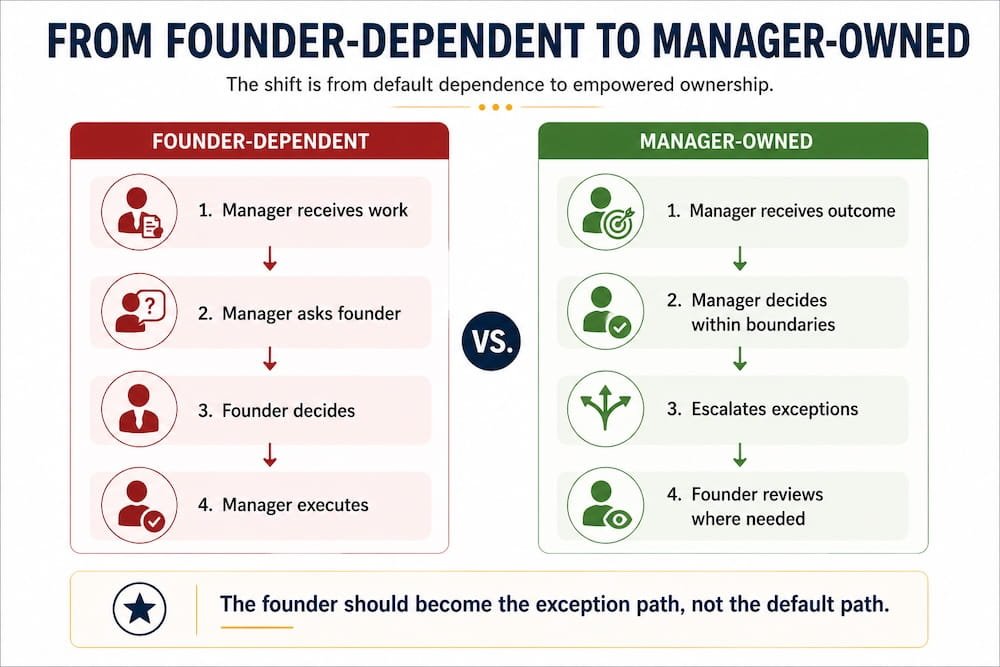
Hiring a manager is the visible change.
Building management capacity is the real change.
The founder may still remain involved for some time. That is normal.
What should change is why the founder is involved.
In the beginning, the manager may need context, guidance, and help thinking through decisions.
Over time, that should reduce.
The manager should become more confident in what they can decide, the team should become clearer about where authority sits, and fewer routine matters should travel back upward.
There is one part of this transition that founders sometimes find difficult.
The manager may make a decision differently from the way the founder would have made it.
That does not automatically make it wrong.
If the outcome is sound, the decision sits within the agreed boundaries, and the risk is acceptable, then some difference in judgment is part of building real management capacity.
Otherwise, the manager may technically have authority but still feel pressure to reproduce the founder’s exact answer every time.
And that creates another form of dependency.
A manager can hold the title and still not hold the role.
The shift happens when the manager can carry the work, the decisions, and the responsibility without needing the founder to stand behind every move.
Frequently Asked Questions
Want to Reduce Founder Dependency Without Losing Control?
Hiring a manager is only one part of the shift.
The bigger question is whether the business has enough clarity around roles, decision rights, information, and escalation for that manager to actually carry the responsibility.
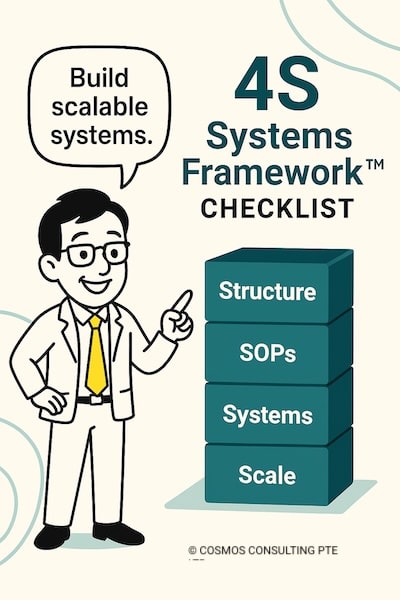
The COSMOS 4S Systems Checklist can help identify where those gaps may still exist across Structure, SOPs, Systems, and Scale.
Use it to see whether the business is genuinely building management capacity, or simply adding another layer between the founder and the team.
Has Your Business Outgrown Informal Operations?
Take the free COSMOS 4S Systems-Maturity Self-Check to identify whether Structure, SOPs, Systems or Scale needs attention first.
Related Reading
If this article feels familiar, these COSMOS pieces continue the same founder-dependency territory from different angles:
- Why Your Business Slows Down After Hiring More People
This looks at what happens when headcount increases, but decision flow and coordination still depend on the founder. - COSMOS 4S Systems Framework™
Useful for understanding how Structure and Systems shape role clarity, decision rights, visibility, and ownership.
Trademark Disclaimer
The COSMOS 4S SME Systems Framework™ and COSMOS 5R Leadership Framework™ are proprietary tools developed by Chhavi Jain, Director, Cosmos Consulting. These frameworks are unregistered trademarks (™) and may not be copied, reproduced, or repurposed without explicit written permission.