Introduction: The Slowdown No One Expects
A business hired three people.
But instead of speeding up…
…everything slowed down.
More follow-ups. More approvals. More waiting.
Many founders don’t realise why business slows down after hiring, because the problem isn’t capacity. It’s how decisions move inside the business.
Work didn’t stop…
… but it stopped moving.
Sales were growing.
The team was expanding.
On paper, everything looked like progress.
But day-to-day execution felt heavier.
Quotations sat longer than they should.
Decisions took extra rounds.
Simple tasks needed multiple nudges.
The founder said it best:
“I thought hiring would make things faster. Why does everything feel harder?”
If this feels familiar, you are not alone.
This is one of the most common and least understood growth problems in SMEs.
Because hiring doesn’t always fix execution.
It often exposes what is already broken.
What Actually Starts to Break After Hiring
At first, the problem doesn’t look obvious.
There are no major failures.
No dramatic collapses.
Just small frictions that start stacking up:
- More handoffs between people
- Decisions waiting for “one final check.”
- Work sitting in inboxes instead of moving forward
- Tasks dependent on one person to move ahead
The team is working.
People are capable.
But work is not flowing…
… it is waiting.
Why Hiring Doesn’t Fix This
The default assumption is simple:
“We hired more people. Things should move faster.”
But here is what actually happens in reality:
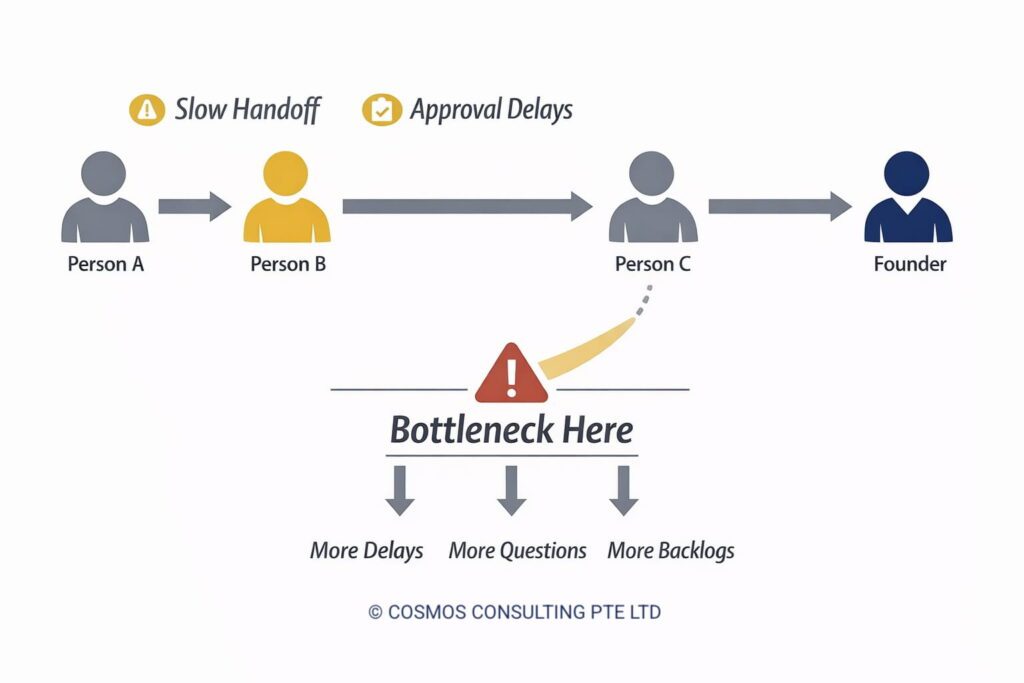
- More people → more handoffs
- More handoffs → more coordination
- More coordination → more delays
And slowly, something critical shifts.
👉 The founder becomes an even bigger bottleneck
Not because they want to.
Because decisions still flow through them.
As teams grow, leaders often end up managing too many decisions directly – a challenge widely discussed in management research (Harvard Business Review).
But in SMEs, the issue goes deeper. It is not just about how many people you manage. It is about how decisions move, or don’t, across the system.
The Real Insight Most Leaders Miss
By the time a business reaches roughly 15–40 people, it has already invested in the basic structure and systems. So something important has already been done:
- Roles are made clear
- SOPs exist
- Systems are in place
So this is NOT:
❌ A people problem or
❌ An execution problem
The structure exists.
The problem is how decisions move.
Your team often knows what to do.
But work still slows.
Why?
Because even though the work structure exists, decisions are not moving.
🟡See COSMOS Case Library on Youtube
If these operating patterns feel familiar, then you can explore the COSMOS Case Library, where we investigate the everyday SME breakdowns and reveal the hidden system gap behind them.
The Real Problem: Why Business Slows Down After Hiring
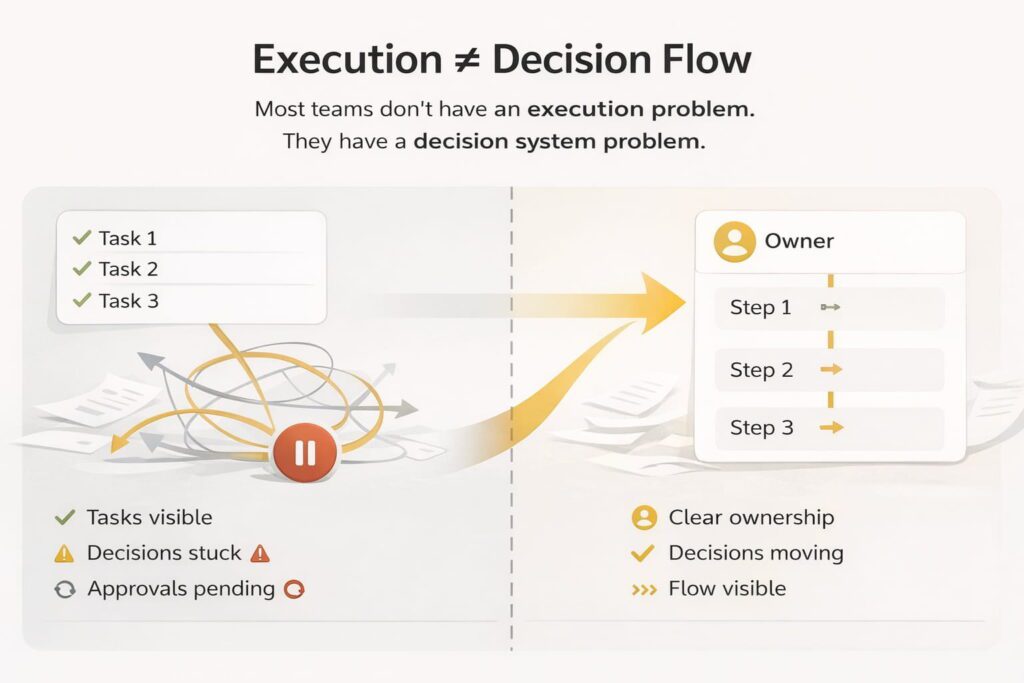
This is where most growing SMEs stall after they have done the obvious fixes: hiring people, defining roles, and setting up systems.
Not in execution.
But in the decision flow.
Here is what is missing:
1. No Review Rhythm
Problems surface too late.
Leaders react instead of seeing patterns early.
2. No Decision Ownership
People do the work…
But decisions still come back to the founder.
3. No Visibility at Decision Level
Leaders can see tasks.
But they cannot see where decisions are getting stuck.
4. No Operating Rhythm
Work exists.
But movement is inconsistent.
This is a leadership system gap.
Why This Happens After Operational Clarity Is Built
This is the turning point most founders don’t expect.
Even without formal frameworks, most SMEs naturally reach a stage where:
But once that foundation exists, a new frustration appears:
“Why am I still chasing people?”
Because systems only create operational clarity.
They do NOT create ownership or decision flow.
And that’s where leadership needs its own system.
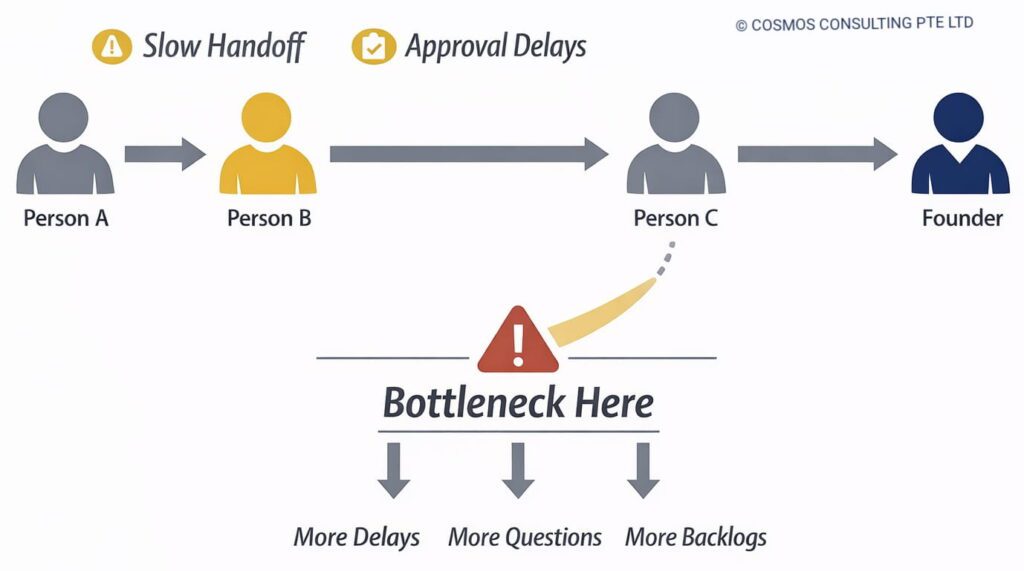
What This Looks Like in Real Life
Picture this…
Sales
Quotes are ready…
But waiting for approval.
Finance
Invoices are raised…
But collections need follow-up.
Operations
Work is moving…
But stuck at cross-team handoffs.
Everything is 80% done.
And waiting for that last decision.
The Shift: From Execution to Decision Flow
At this stage, the goal changes.
You are no longer fixing execution.
You are fixing movement.
Because:
Work doesn’t slow down because people are inefficient.
It slows down because decisions are stuck.
This is the stage where most SMEs get stuck.
Not because they lack systems.
But because they lack a leadership system.
Where COSMOS 5R Leadership Framework™ Comes In
This is exactly why the COSMOS 5R Leadership Framework™ exists.
Not to “motivate” teams.
Not to “manage” people.
But to systemise leadership itself.
Here is what that actually looks like in practice:
- A weekly review rhythm so that issues don’t surface late
- A simple way to record key decisions so that they don’t stay in someone’s head
- Clear ownership of decisions so that work doesn’t come back to the founder
- Basic visibility so that leaders can see where work is getting stuck
- Reinforcement of the right behaviours so that the system sustains
(For a full breakdown of how this works, explore the COSMOS 5R Leadership Framework™.)
If 4S builds how work runs, 5R ensures how work moves.
Turn This Insight Into Action
Explore the COSMOS Vault for free checklists, starter kits, guides and ready reckoners designed to help you strengthen everyday SME operations.
Find practical tools for structure, SOPs, visibility, ownership, reporting and scale.
Closing Insight
Most founders assume growth problems come from:
- Hiring gaps
- Skill gaps
- Effort gaps
But the real shift is this:
Growth slows when decisions don’t scale.
And decisions don’t scale on effort.
They scale on systems.
Related Posts
- Still Doing Everything Yourself? Start with Structure
- You Don’t Have a Team Problem. You Have a Clarity Problem.
- Cross-Department Gaps in SMEs: Why Growing Businesses Drift Into Silos (And How to Fix It Structurally)
- You Can’t Fix What You Can’t See: How Operational Blind Spots Derail Growing Businesses
CTA
If your business feels slower after hiring…
Pause before adding more people.
Start by asking:
👉 Where are decisions getting stuck?
That answer will tell you exactly what to fix next.
Trademark Notice
The COSMOS 4S Systems Framework™ and COSMOS 5R Leadership Framework™ are proprietary tools developed by Chhavi Jain, Director, Cosmos Consulting. These frameworks are unregistered trademarks (™) and may not be copied, reproduced, or repurposed without explicit written permission. © Cosmos Consulting, 2025. All rights reserved.