A manufacturing SME had a formal process for arranging transport.
Use an approved transporter. Confirm the rate. Book the vehicle. Update the dispatch tracker.
One afternoon, the regular transporter had no truck available.
So the dispatch team called another transporter on WhatsApp. A truck came. The shipment moved. Problem solved.
The next time transport was urgent, they used WhatsApp again. Then again.
Soon, bookings were happening in chats first and the tracker was being updated later. And because of this, sometimes. – Rates sat in messages. – Vehicle details sat on phones.
And eventually, the new employee was told: “The tracker is the official system. But for actual bookings, just WhatsApp these people.”
Want more SME cases like this?
Follow the COSMOS Case Library on YouTube.
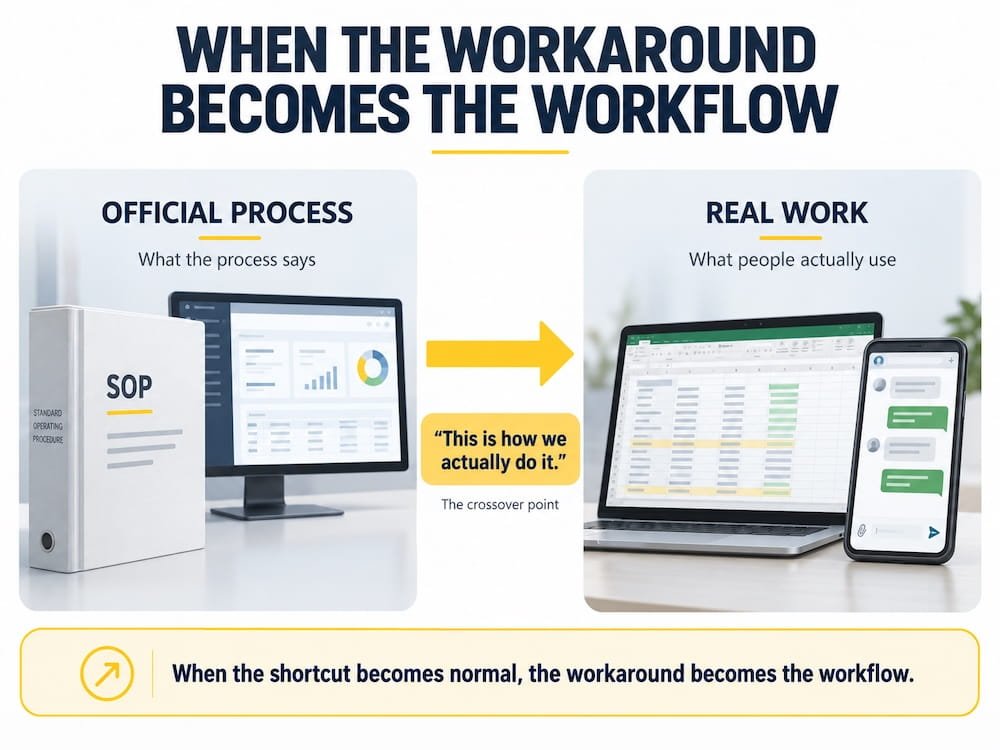
This is the point where a workaround stops supporting the official process and starts replacing it. Workarounds in business processes often begin exactly like this: as sensible exceptions created to solve a real operating problem.
The exception becomes the system when it is easier to use than the system itself.
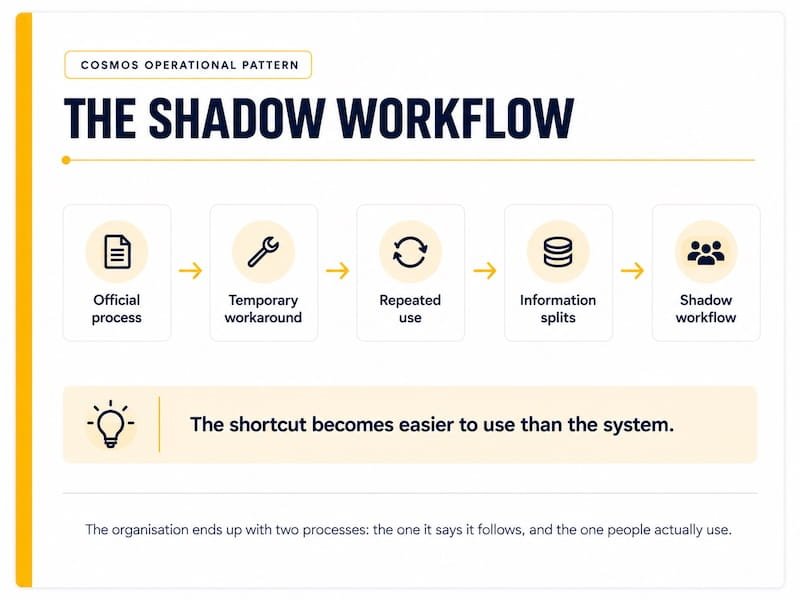
COSMOS OPERATIONAL PATTERN
The Shadow Workflow
A workaround starts as an exception. But when it is easier to use than the official route, it eventually becomes the go-to route.
Official process ↓ Temporary workaround ↓ Repeated use ↓ Shortcut becomes easier ↓ Information starts splitting ↓ Official system becomes incomplete ↓ People trust the unofficial route more ↓ The workaround becomes the real workflow
That is The Shadow Workflow.
The official process still exists, but it is no longer carrying the real work. Updates, decisions and information have started moving through another route.
The organisation has two processes:
the process it says it follows. and the process people actually use.
A workaround becomes dangerous when the organisation starts trusting the shortcut more than the designed process.
Why Workarounds Appear in Business Processes
Workarounds in business processes usually begin because the normal route does not fit a particular situation well enough. And this can happen for several reasons:
The process may have too many steps.
An approval may take too long.
The system may not support a particular exception.
The information people need may be difficult to access.
Or the process may have been designed when the business was smaller and the operating reality has since changed.
So the team finds another way to keep the work moving. That route may be informal, but it often solves a real problem.
And that is exactly why it gets used again.
The important point is that repeated workarounds usually do not appear randomly. They are often a sign that something in the official process is creating friction.
A workaround gets repeated because, in that moment, it is easier than the designed route.
When a Workaround Becomes a Shadow Workflow
There is no fixed number of days or uses after which a workaround becomes a Shadow Workflow. The shift happens when the organisation starts treating the alternative route as normal.
Other signals appear too:
people use it even when the original exception is gone.
the unofficial route is checked before the official one.
the official record is updated after the fact.
the business depends on people who know the shortcut.
new employees are taught, “This is how we actually do it.”
That last signal matters most.
Once new employees are being taught the unofficial route as normal work, the workaround has become a Shadow Workflow.
Two Processes Create Two Versions of Reality
Once the workaround starts carrying real work, information begins to split.
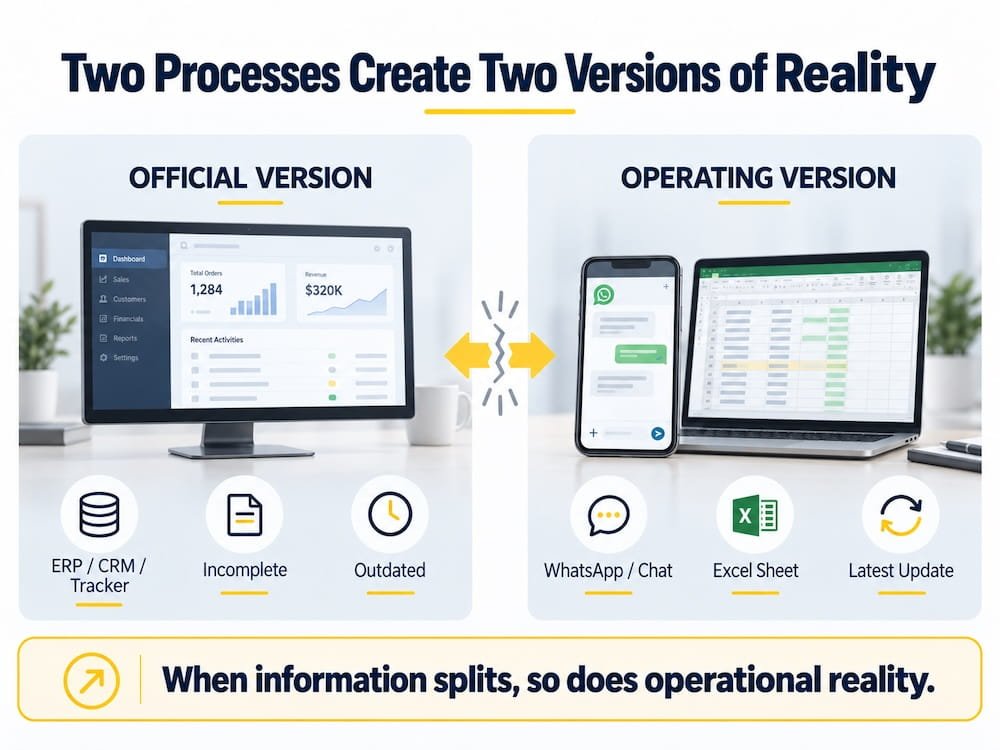
One version sits in the official system. Another sits in the unofficial route people actually use.
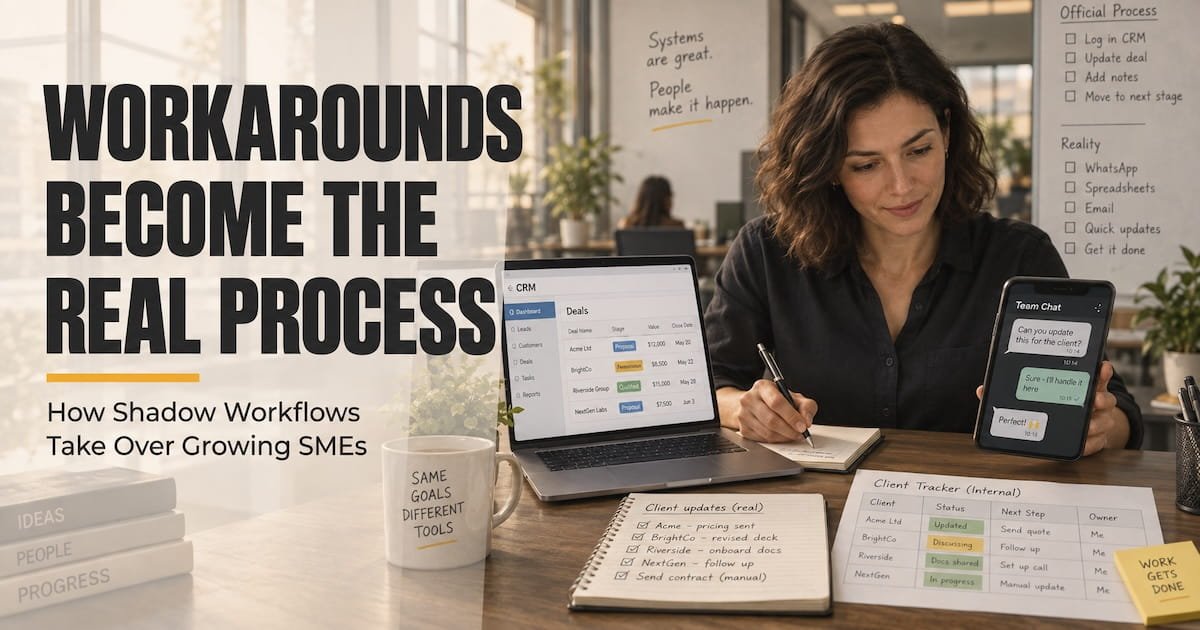
The CRM may show one status, while the WhatsApp conversation holds the latest update. The ERP may show one production position, while the Excel sheet reflects what is really happening.
At first, this may look like a minor inconvenience. But over time, the gap becomes operationally expensive.
People stop knowing which source to trust. Updates have to be cross-checked.
Managers start chasing people for the “real” status. Decisions get made using partial information. And the official system becomes less reliable simply because it no longer contains the full picture.
That creates a damaging cycle: The official system becomes incomplete.
So people trust it less. And because they trust it less, they update it less consistently. And because it is updated less consistently, it becomes even less useful.
Eventually, the organisation is working from several partial realities.
The Shadow Workflow has now created a second source of operational truth.
What the Shadow Workflow Is Telling You About the Official Process
By this stage, the Shadow Workflow is no longer just a workaround.
It is evidence. If the same unofficial route keeps being used, the business needs to understand what that pattern is revealing.
There are usually three possibilities.
1. The exception is genuinely exceptional
Sometimes the official process is still sound. The workaround was needed only because of an unusual situation.
In that case, the official process may still be sound. The exception simply needs to remain an exception.
2. The official process has unnecessary friction
Sometimes the repeated workaround is exposing a problem in the designed process.
Perhaps one step is slower than it needs to be. Perhaps an approval no longer adds value. Perhaps the system does not support a common real-world situation.
In that case, removing the workaround without changing the process will probably recreate the same problem somewhere else.
3. The workaround has revealed a better way of working
Occasionally, the unofficial route works better because it has adapted to how the business now operates.
That does not mean the workaround should simply be left alone.
It may mean that the workaround has revealed a better process than the one currently documented.
The important question is therefore not: “How do we force everyone back into the documented process?”
It is: “Which process should actually carry the work now?”
A Shadow Workflow is often a clue that the designed process and the operating reality have started to drift apart.
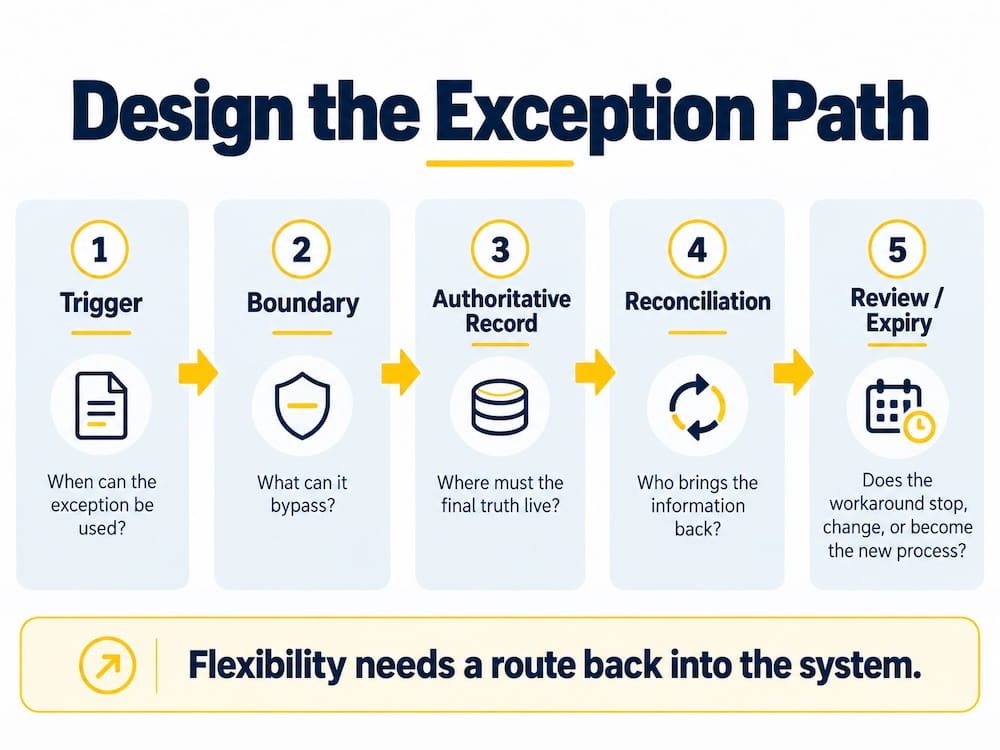
Design the Exception Path, Not Just the Normal Path
Growing SMEs will always have exceptions. And they need enough flexibility to handle them.
The goal is not to eliminate every workaround. The real need is to make sure the exception does not quietly become a second operating system.
That means the exception path itself needs some process.
1. Define when the exception is allowed
Be clear about what kind of situation justifies using a different route. The team should know what genuinely counts as an exception and what should still follow the normal process.
Urgency alone is often too vague.
2. Define what the workaround can bypass
A shortcut may bypass one step. It should not automatically bypass everything.
For example, an urgent transport booking may happen outside the usual booking route, but the approved rate, transporter details, and final dispatch record may still need to be captured.
3. Keep one authoritative record
The work may temporarily happen somewhere else. The final status should not.
There should still be one place where the organisation can see the complete and current position. Otherwise the workaround becomes another source of truth.
4. Reconcile the exception back into the system
Someone needs to be responsible for bringing the missing information back.
What happened? What was decided? Who approved it? What changed? What is the final status?
If that reconciliation step is missing, the official system will gradually become incomplete.
5. Give the workaround an expiry or review point
A temporary route should not continue indefinitely without anyone noticing. If the workaround keeps getting used, the business needs to decide what happens next.
Does it stop? Does the official process need to change? Or has the workaround actually revealed a better process that should now be formalised?
The important thing is that the decision is made consciously.
Flexibility works best when the exception has a clear way back into the system.
The COSMOS Perspective
From a COSMOS point of view, this is primarily an SOPs + Systems issue.
The SOP defines the intended route and what should happen when reality does not fit the normal path.
The system makes sure the organisation still has one visible, reliable version of what actually happened.
R2: Record matters because exceptions cannot live only in messages, memory, or somebody’s personal spreadsheet.
R4: Report matters because the organisation still needs one shared view of status, progress, and exceptions.
The aim is not to make every exception bureaucratic. It is to make sure flexibility does not destroy visibility.
The workaround may happen outside the normal route. The organisational memory should not.
Flexibility Is Not the Problem. Invisible Parallel Processes Are
Growing SMEs need exceptions.
The danger begins when an exception stops being visible as an exception and quietly becomes the route people depend on.
That is how a Shadow Workflow takes hold: the documented process remains in place, while the real work moves somewhere else.
The answer is not to eliminate flexibility. It is to design exceptions with boundaries, reconciliation and one authoritative record, and to review recurring workarounds for what they reveal about the process itself.
The exception becomes the system when it is easier to use than the system itself.
Frequently Asked Questions
Workarounds in business processes are an alternative way of completing work when the normal process does not fit a particular situation.
It may begin as a practical response to urgency, a system limitation, a missing approval, or another operating exception.
But the risk begins when that alternative route keeps being used without being brought back into the official process.
A workaround becomes a shadow workflow when it stops being an occasional exception and starts becoming the route people rely on to get the real work done.
A strong sign is when new employees are taught the unofficial route as “how we actually do it.”
No. Growing businesses need flexibility, and temporary workarounds can be useful.
The problem is not the workaround itself. The problem is allowing it to continue without clear boundaries, reconciliation, or one reliable source of truth
Start by defining:
when the exception is allowed
what it can bypass
where the final information must be recorded
who reconciles it back into the official system
when the workaround must be reviewed
That keeps flexibility available without allowing a parallel process to grow unnoticed.
Ready to Check Where Your Process Is Breaking?
The real risk with workarounds in business processes is not that exceptions exist. It is that the exception quietly becomes the operating route.
If the process people follow is different from the process written down, the gap is already worth examining.
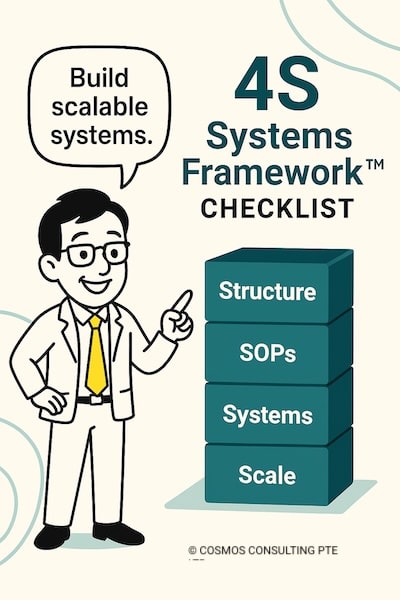
The COSMOS 4S Systems Checklist helps you review whether your Structure, SOPs, Systems and Scale mechanisms are actually supporting how work happens inside the business.
Use the checklist to identify where the designed process and the real operating process have started to drift apart.
COSMOS 4S SYSTEMS FRAMEWORK™
Has Your Business Outgrown Informal Operations?
Take the free COSMOS 4S Systems-Maturity Self-Check
to identify whether Structure, SOPs, Systems or Scale
needs attention first.
Looking for a different starting point?
Explore free checklists, starter kits, guides and ready reckoners in the
COSMOS Vault →
The COSMOS 4S SME Systems Framework™ and COSMOS 5R Leadership Framework™ are proprietary tools developed by Chhavi Jain, Director, Cosmos Consulting. These frameworks are unregistered trademarks (™) and may not be copied, reproduced, or repurposed without explicit written permission.
To provide the best experiences, we use technologies like cookies to store and/or access device information. Consenting to these technologies will allow us to process data such as browsing behavior or unique IDs on this site. Not consenting or withdrawing consent, may adversely affect certain features and functions.
Functional
Always active
The technical storage or access is strictly necessary for the legitimate purpose of enabling the use of a specific service explicitly requested by the subscriber or user, or for the sole purpose of carrying out the transmission of a communication over an electronic communications network.
Preferences
The technical storage or access is necessary for the legitimate purpose of storing preferences that are not requested by the subscriber or user.
Statistics
The technical storage or access that is used exclusively for statistical purposes.The technical storage or access that is used exclusively for anonymous statistical purposes. Without a subpoena, voluntary compliance on the part of your Internet Service Provider, or additional records from a third party, information stored or retrieved for this purpose alone cannot usually be used to identify you.
Marketing
The technical storage or access is required to create user profiles to send advertising, or to track the user on a website or across several websites for similar marketing purposes.