
The phone rings.
A customer needs an urgent order.
“If you can deliver this by next month, we’ll place the order.”
You know this customer matters.
So you walk into production.
“This urgent customer order needs to become our top priority.”
The production team looks at the schedule.
Then someone asks a simple question.
“Which existing order would you like us to delay?”
Suddenly, the decision doesn’t feel so simple.
From your perspective, you are trying to help an important customer.
From production’s perspective, you are changing commitments that were made weeks ago.
Neither side is wrong.
They are simply looking at different parts of the business.
See how this pattern unfolds inside a real SME:
Want more SME cases like this?
Follow the COSMOS Case Library on YouTube.
This situation plays out in growing SMEs every day.
The problem isn’t that urgent customer requests exist.
The problem is that new priorities are often decided without seeing the commitments already in motion.
COSMOS OPERATIONAL PATTERN
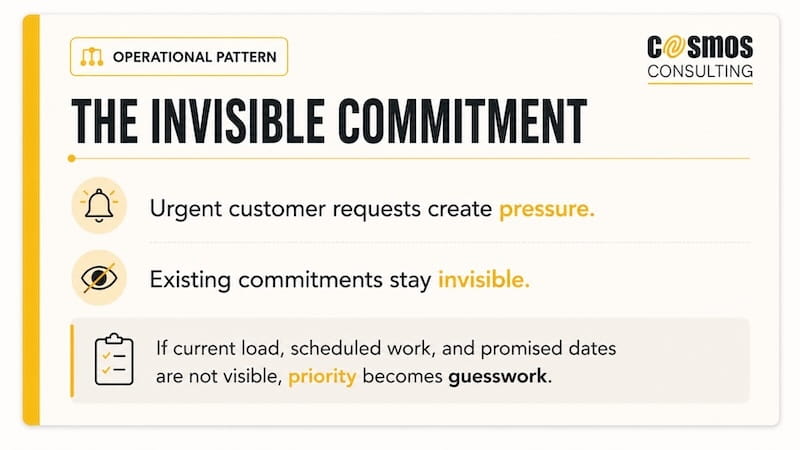
The Invisible Commitment
Every urgent customer request feels important.
So it is very natural to focus on the new opportunity that comes your way.What often disappears from view are the commitments that have already been made.
- Orders already scheduled.
- Production already started.
- Delivery dates already promised.
The moment those commitments become invisible, every new request feels like it can be accommodated.
This is where production plans start changing, delivery promises begin to slip, and the team starts feeling like they are constantly firefighting.The problem isn’t the urgent order.
The problem is that existing commitments were never part of the decision.
Why Urgent Orders Feel Difficult to Refuse
An urgent customer request rarely arrives as a simple production decision.
It may come from an important customer.
It may carry the promise of a larger order.
It may be linked to a site deadline, a project launch, or an unexpected breakdown.
From a commercial perspective, saying yes can feel like the right decision.
The difficulty begins when the request is considered on its own.
The new order is visible.
The opportunity is immediate.
The customer is waiting for an answer.
But what is less visible are the orders already in production and the delivery commitments already made to other customers.
This is why an urgent order can appear manageable at the point of decision, yet create disruption once it reaches operations.
The issue is not that the request is important.
The issue is that its importance is being judged without the full operational picture.
The Commitments Already in Motion
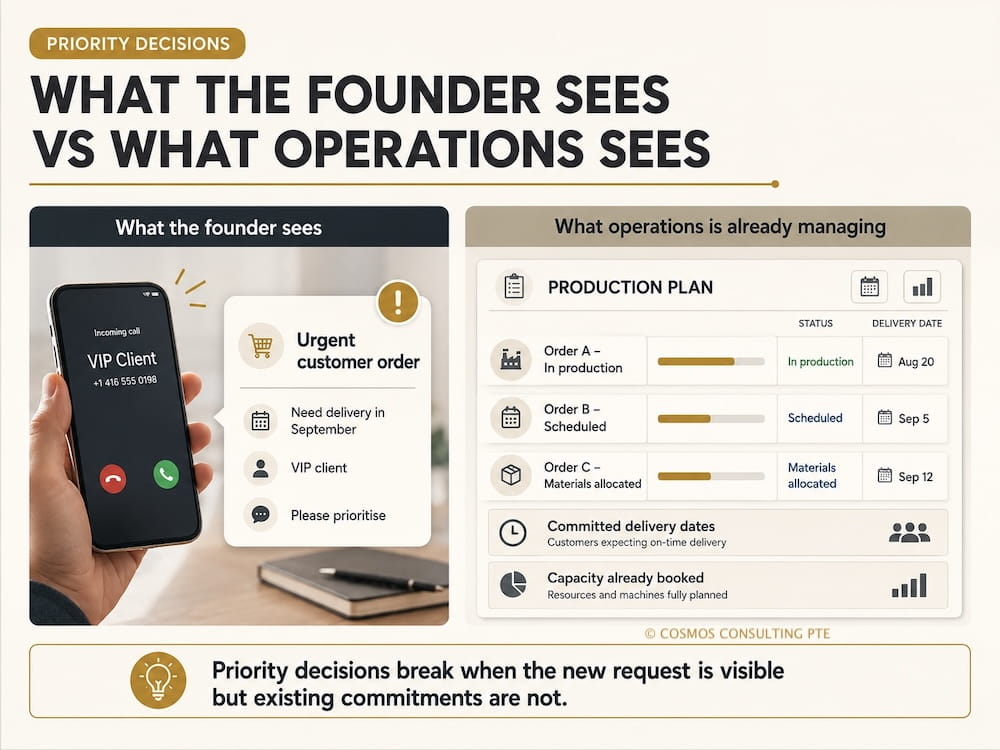
An order does not remain a line on the production schedule once work begins.
By that stage, several operational commitments may already be tied to it:
- Raw materials may have been issued.
- Machines may have been set up.
- Operators may already be working on it.
- Quality checks may be planned around it.
- Packing and dispatch may already be coordinated.
- Another customer may be relying on the promised delivery date.
This is why changing production priority at this stage is rarely simple or consequence-free.
Stopping work midway can create wasted setup time, idle material, incomplete batches, and confusion over what should resume next. In some cases, finishing the work already started is faster and less disruptive than interrupting it.
From outside the production floor, the schedule may still look flexible.
But from inside, the production work is already connected to people, materials, machines, and delivery promises.
That is why production teams may push back when a new urgent order is inserted into the plan.
Their intent is not necessarily to resist the customer request.
They are just trying to protect the commitments that are already in motion
Priority Without Visibility Is Guesswork
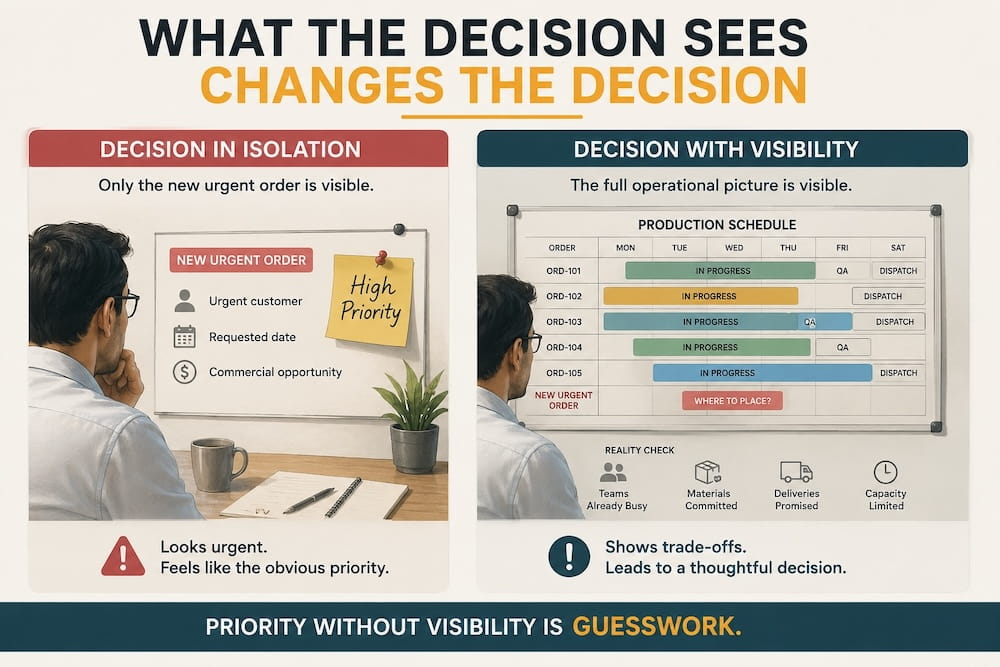
When an urgent order arrives, the decision is often framed as:
Can production accommodate this?
But that is not the complete question.
The real question should be:
What will be needed to change if this order is accepted?
A production plan contains more than available hours. It also contains sequencing, material availability, setup requirements, customer deadlines, and promises already made. Manufacturing research notes that rush orders can overtake an existing shop-floor schedule, requiring the schedule to be revised or repaired.
Without seeing those dependencies, an urgent order may appear possible, simply because the consequences are not yet visible.
That is why priority decisions should never be made in isolation.
Before changing the plan, the business needs to understand:
- Which orders are already committed
- Which work has already started
- What capacity is genuinely available
- Which delivery dates may be affected
- What trade-off is being made
Only then does an urgent request become a real operational decision.
Until then, it is only an assumption.
Priority without visibility is guesswork.
What High-Visibility Businesses Do Differently
High-visibility businesses do not avoid urgent orders.
They make the trade-offs visible before changing the plan.
That means, when an urgent order is received, operations is first asked to show the full picture:
- What is already committed
- What has already started
- Which delivery dates may move
- What capacity is genuinely available
- What will be affected if the new order is prioritised
Only after both commercial urgency and operational reality are visible can an informed decision be made.
However, there will be situations where the new order still needs to take priority.
In that case, the business looks for the least damaging option.
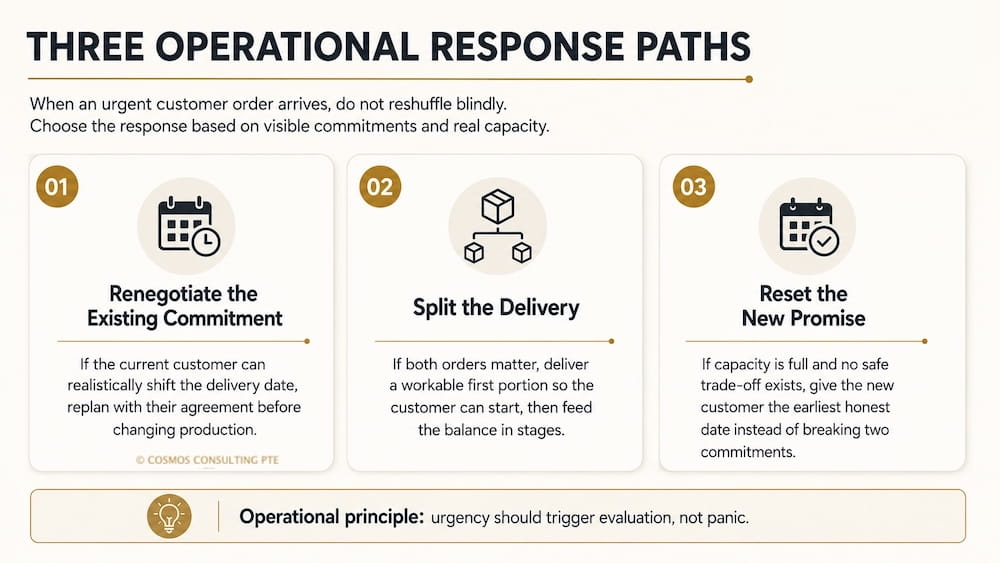
1. Check whether an existing delivery date can move
An existing customer may be able to accept a later date.
The important point is to ask, not assume.
A small extension may create enough space to accommodate the urgent order without damaging either relationship.
2. Explore partial deliveries
Both customers may not need the full order at once.
A smaller first batch may allow one customer to begin work while the remaining quantity is completed later.
This can reduce the pressure of choosing one order over the other.
3. Be honest about what is possible
When neither delivery date can move and partial delivery is not practical, the new customer should be given the earliest realistic date.
Accepting an urgent order does not help the business if it creates two missed commitments instead of one honest conversation.
The goal is not to stop priorities from changing.
The goal is to understand exactly what will change before the decision is made.
The COSMOS Perspective
Within the COSMOS 4S Systems Framework™, this is primarily a Systems problem, supported by Structure.
The Systems gap appears when production commitments, capacity, and work already in progress are not visible at the point where a new decision is made.
The Structure gap appears when it is unclear who can change priorities and what information must be reviewed before that decision is approved.
A stronger operating system does not prevent urgent requests from arriving.
It creates a clear decision process:
- Operations presents the current production position.
- Sales or the founder provides the commercial context.
- The impact on existing commitments is reviewed.
- The business decides whether to retain the existing plan, revise delivery dates, split deliveries, or decline the new request.
- The final decision is recorded and communicated to everyone affected.
This creates a shared understanding of both the opportunity and the cost of accepting it.
The urgent order may still be approved.
But it is approved as a conscious business trade-off, not as an isolated instruction passed into production.
The Decision Is Not Whether the Order Is Urgent
The real decision is whether the business can accommodate the order without making promises it cannot keep.
Sometimes, the urgent order should be accepted.
Sometimes, the existing schedule can be redesigned.
Sometimes, partial deliveries can protect both customer relationships.
And sometimes, the most responsible decision is to give the new customer a realistic date instead of an attractive one.
Urgent customer orders do not create chaos on their own.
Chaos begins when the new request becomes visible while the commitments already in motion disappear from the decision.
Good operational decisions do not begin with the urgent request. They begin with a clear view of the commitments already in motion.
Frequently Asked Questions
Want to Make Operational Commitments More Visible?
Urgent requests are easier to evaluate when the business already has clear roles, documented workflows, and visible systems.
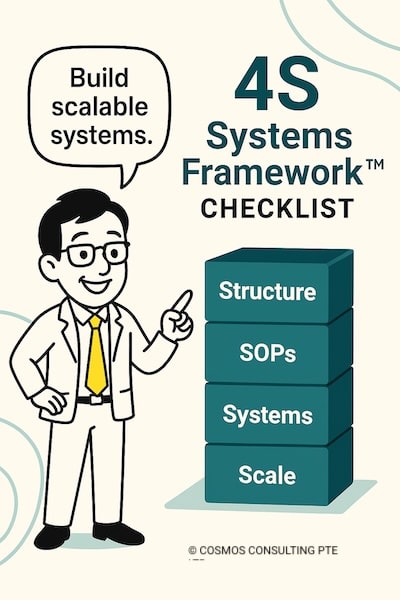
Use the COSMOS 4S Systems Checklist to identify where Structure, SOPs, Systems, or Scale may be creating hidden operational gaps.
Has Your Business Outgrown Informal Operations?
Take the free COSMOS 4S Systems-Maturity Self-Check to identify whether Structure, SOPs, Systems or Scale needs attention first.
Related Reading
- How the 4S Systems Framework Helps SMEs Scale Without Chaos, Burnout, or Bottlenecks
- Dashboards Don’t Have to Be Ugly — Systems That Make Teams Self-Manage
- Still Doing Everything Yourself? Start with Structure
.
Trademark Disclaimer
The COSMOS 4S SME Systems Framework™ and COSMOS 5R Leadership Framework™ are proprietary tools developed by Chhavi Jain, Director, Cosmos Consulting. These frameworks are unregistered trademarks (™) and may not be copied, reproduced, or repurposed without explicit written permission.
© Cosmos Consulting, 2026. All rights reserved.