I. The Real Problem: SOPs Sound Easy… Until You Try Writing One
Most SME owners know they should have SOPs – and so they download a few small business SOP templates that seem to match the problem they are dealing with, ask their admin to “document the steps,” and file it neatly into a shared drive.
But what really changes after that? Almost nothing.
Tasks still vary from business to business, and even from person to person. What works for one company rarely works for another, even if the problem looks the same.
The result? Inconsistency, confusion, and the same mistakes repeated until the owner has to step in again.
It is not that SOPs don’t work… it is that most small businesses rely on templates that don’t fit their actual workflow.
This is something that deserves a closer look.
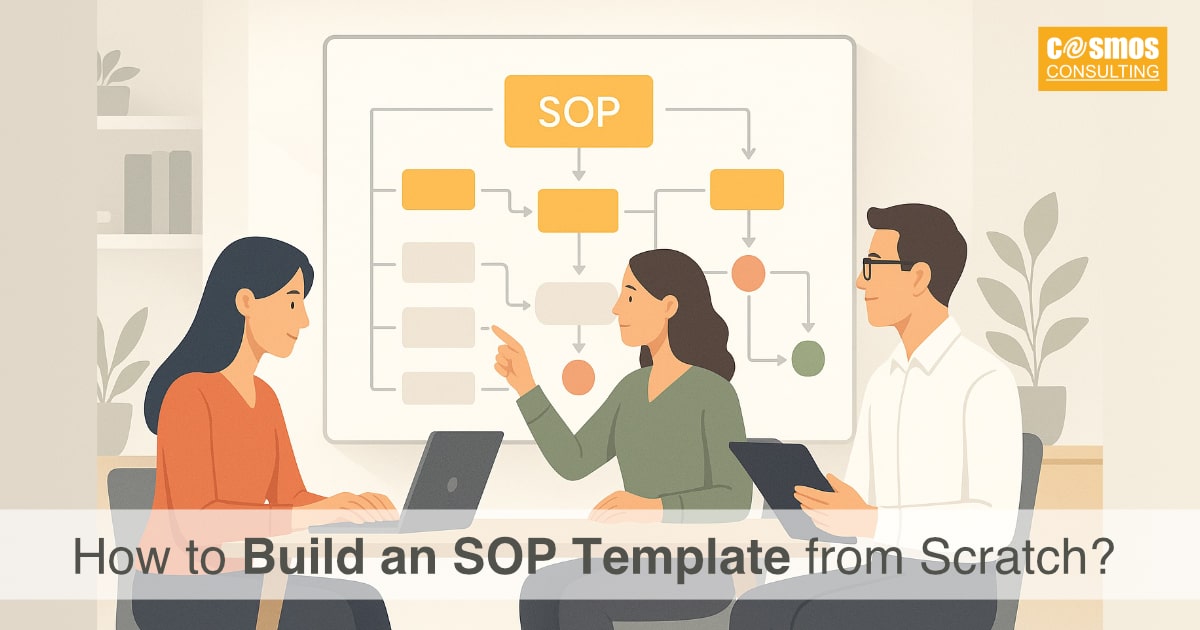
Let us dig deeper and see how a small business SOP template can be built from scratch… one that fits your business, your team can actually understand, and that they will use for what it is meant to do… with examples and a few hard-earned lessons from the field.
II. Why Every SME Needs a Real SOP Template
A good SOP is not paperwork… it is a clarity tool.
It helps your team know:
- Who is responsible for what.
- How tasks should be done consistently
- What success looks like
And when you start scaling: adding new team members, new products, or even new branches – that clarity saves you hours (and sanity).
(If you are still questioning why SOPs matter in the first place, read our earlier post – SOPs for SMEs Can Save Your Business – where we covered the “why.” This one focuses on the “how.”)
Even ISO 9001’s Process Approach Principles emphasize documenting what is actually done – not writing rules no one follows. Your small business SOP template should aim for the same: clarity, not compliance.
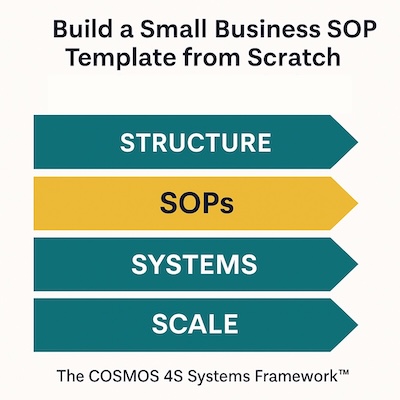
In the COSMOS 4S Systems Framework™, SOPs form the second step –
Structure → SOPs → Systems → Scale
They translate structure into action. Without them, you cannot build systems that actually work.
III. The Anatomy of an Effective Small Business SOP Template
Forget fancy formats or expensive tools. Every SOP just needs the same three things:
1. Context
➤ Why does this SOP exist? What is its purpose?
2. Clarity
➤ What steps are followed, by whom, and in what order?
3. Consistency
➤ How do you ensure everyone follows it the same way every time?
Here is a practical small business SOP template you can adapt:
SOP Title: [e.g., Purchase Request to Payment]
Department: [Procurement / Finance / HR]
Owner: [Person responsible for updating this SOP]
Last Updated: [Date]
Objective:
A one-line reason why this process exists.
Scope:
Where this SOP applies (e.g., local purchases, service invoices, etc.)
Process Steps:
1. [Who] does [what] using [which tool]
2. [Next step]
3. [Next step]
Checklist:
– All supporting documents verified
– Approval recorded in system
– Invoice logged for payment
Exceptions:
What happens when something doesn’t follow the normal flow.
Review Date:
Set a reminder to revisit every 6–12 months.
🟡 COSMOS Tip (Pro): Write the SOP for the person doing the task, not for the auditor reviewing it. Replace jargon with verbs – “Submit claim via MYOB” reads better than “Claim submission process.”
IV. Step-by-Step: How to Build Your SOP Template From Scratch
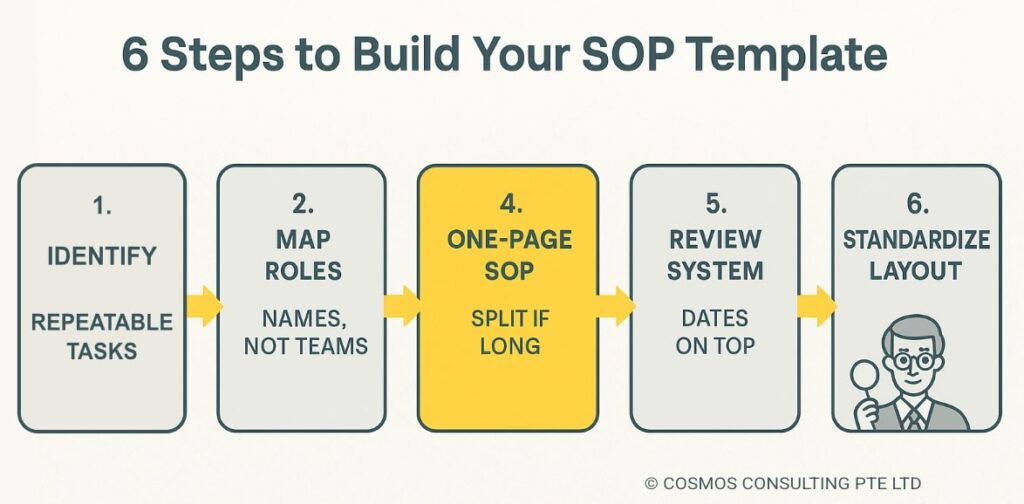
Step 1: Identify Repetitive Tasks
↳ Start with anything you or your team does at least twice a week.
E.g. “Prepare quotation,” “Approve leave,” “Update stock.”
↳ List 5–10 of these. That is your first SOP batch.
Step 2: Map Roles Clearly
↳ Don’t write “Admin Team.” Write names or roles: “Amy(Accounts), Fatin (Logistics).”
If you cannot assign a name, you don’t have clarity yet.
Step 3: Capture the Real Flow
↳ Sit with the person doing it. Watch them do it once.
↳ Ask, “What do you do next?” or “Where does this get stuck?”
↳ Record every click, every handover.
Step 4: Write a One-Page SOP
↳ Limit yourself to one page per SOP.
↳ If it is longer, break it into sub-SOPs (e.g., “Purchase Request” vs “Purchase Approval”).
Step 5: Add a Review System
↳ Put a ‘Last Updated’ and ‘Next Review’ date right on the top.
↳ Most SOPs fail because they age silently.
Step 6: Standardize the Template Format
↳ Once the first few SOPs work, lock that layout.
↳ Use the same structure for all departments… it saves time later.
V. Example: Purchase Request to Payment (for SME)
Here is what a simplified real-life SOP might look like for a manufacturing SME:
SOP Title: Purchase Request to Payment
Department: Procurement + Finance
Owner: Aina (Procurement)
Last Updated: Sept 2025
Objective: To ensure all purchases are authorized, recorded, and paid on time.
Scope: Applies to all local vendor purchases above USD 200.
Process Steps:
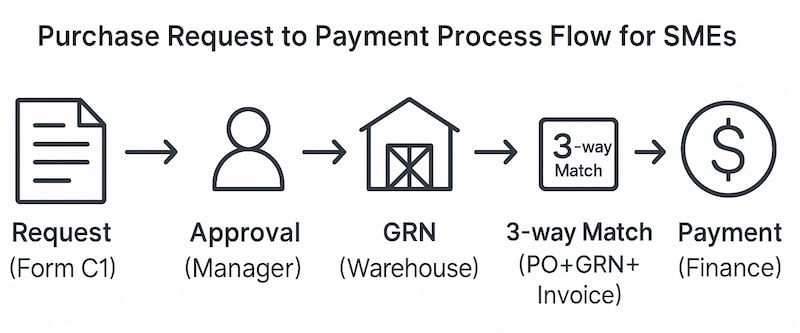
- User raises purchase request using Form C1.
- Procurement verifies stock availability and vendor status.
- Manager approves via MYOB workflow.
- Finance issues Purchase Order.
- Goods received are verified by warehouse (GRN form).
- Vendor invoice matched to GRN and PO before payment.
Checklist:
☐ Vendor in approved list
☐ PO signed
☐ Invoice uploaded
☐ Payment date noted
Exceptions: For urgent repairs, verbal approval may precede documentation.
Review Date: March 2026
VI. Common Customizations by Function
| Function | Example SOP | Special Element |
|---|---|---|
| Finance | Petty Cash Reimbursement | Include cash limit + approval hierarchy |
| HR | New Hire Onboarding | Checklist of required documents |
| Logistics | Goods Receipt | Add photo log or serial number field |
| Service | Client Feedback Closure | Add SLA and customer response tracker |
🟡 COSMOS Tip: Never copy another department’s SOP. Same format, yes… Same content, no.
VII. Bringing It All Together
Your first SOP doesn’t have to be perfect. It just has to be real… reflecting how your team actually works.
- Start small.
- Test one SOP.
- Let the team own it.
- Review and refine.
Once SOPs are consistent, you can connect them into dashboards or automated systems – the third step of the COSMOS 4S Systems Framework™.
Start Documenting the Work
Explore the COSMOS Vault for the free SOP Starter Kit and other practical resources that can help you make important work clearer, more consistent and easier to repeat
When that happens, operations stop depending on memory… and start running on muscle.
VIII. Reflective Takeaway
Small businesses don’t fail because they lack effort… they fail because effort isn’t organized.
An SOP is your first step toward an organized effort.
You don’t need a consultant to start, but you do need commitment to finish.
IX. FAQ – Small Business SOP Template
Related Blogs
- Why Lean Thinking Alone Isn’t Enough for SMEs and What COSMOS 4S Does Better
- Why Most Lean Projects Fail in SMEs (and How 4S Can Fix It)
- Top 6 SOP Implementation Challenges (and How to Fix Them)
- How to Run Lean Team Operations: SOPs, Automations & Visibility
X. Call to Action
Have you tried creating SOPs for your team?
What is the hardest part – starting, explaining, or getting people to follow them?
Share your experience in the comments… and if you would like a free SOP Starter Kit, download it from the COSMOS Resources Vault.
Get the SOP Starter Kit & More
Download this and other free templates from the
COSMOS Resources Vault.
SOP Starter Kit • 4S Checklist • Dual Framework Guide • Ready Reckoners