🎥 RELATED COSMOS CASE
See how this operational pattern unfolds inside a real SME.
Want more SME cases like this?
Follow the COSMOS Case Library on YouTube.
🟡 Did this pattern feel familiar?
Explore the COSMOS Case Library on YouTube, where everyday SME breakdowns are investigated to reveal the hidden system gap behind them.
Meetings without outcomes are rarely caused by poor communication. More often, they happen because teams have no reliable system for tracking work once the meeting ends.
“We have already discussed this.”
If you have said that more than once this month, your business probably doesn’t have a meeting problem.
It has a work visibility problem.
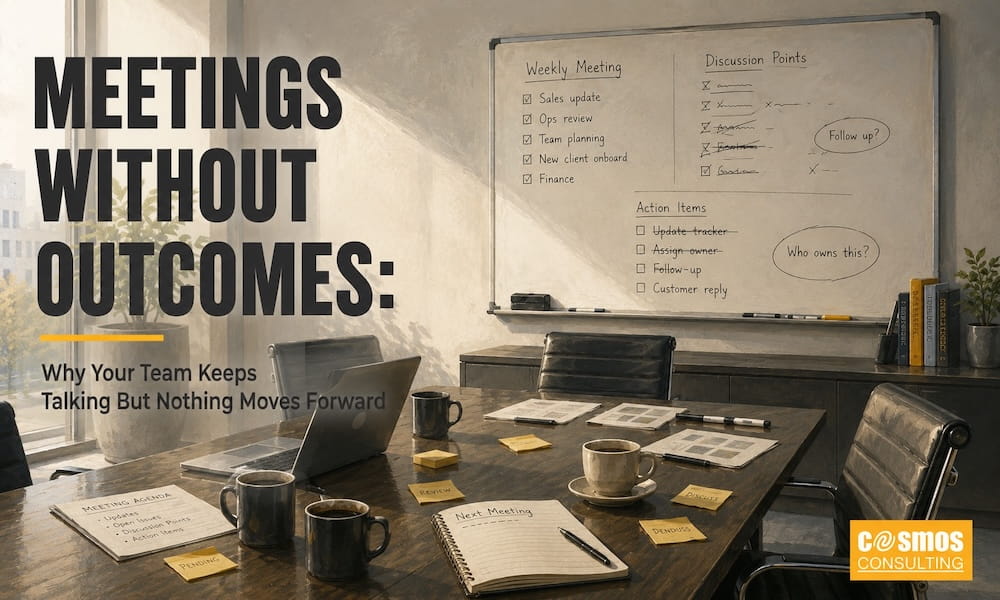
Many growing SMEs hold regular meetings because they believe better communication will naturally lead to better execution. Yet these often become meetings without outcomes, where updates are shared, decisions are made, but very little moves forward once everyone leaves the room.
A few days later, the same questions return.
“What’s the status?”
“Who was supposed to do this?”
“Didn’t we already agree on this?”
Meetings without outcomes usually happen when meetings become the only place where work is visible. They stop being a management tool and become a substitute for a missing tracking system.
Research from Harvard Business Review has consistently shown that poorly managed meetings waste significant organisational time, but the issue often goes deeper than meeting quality alone. In many SMEs, the real problem is that decisions are never translated into visible, trackable work.
Why Meetings Feel More Productive Than They Really Are
Meetings create a comforting sense of progress.
Everyone is present.
Ideas are exchanged.
Problems are discussed.
Action items are assigned.
For an hour, the business feels aligned.
This is why founders often leave meetings feeling optimistic.
Communication has happened, decisions have been made, and everyone appears to be on the same page.
But conversations are not the same as execution.
Nothing actually moves forward until the work is completed, tracked, and made visible after the meeting ends.
That is where many SMEs begin to lose control.
What Happens After Everyone Leaves the Room
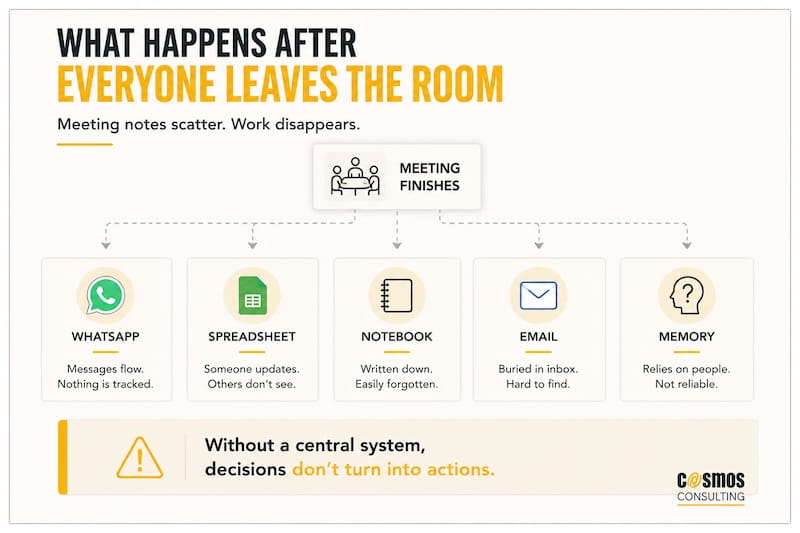
Once the meeting ends, work scatters.
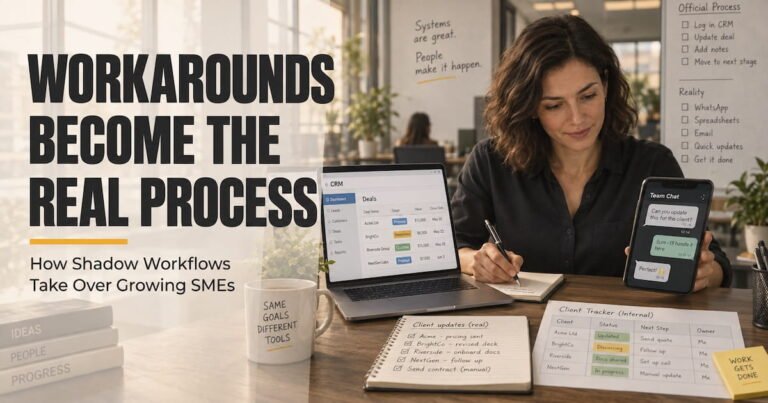
Some updates are shared on WhatsApp.
Some are written in personal notebooks.
Others are remembered mentally.
A few are added to spreadsheets.
Some simply disappear into busy work.
Within a day or two, nobody has a complete picture anymore.
Questions that should have simple answers suddenly require another conversation.
- Who owns this task?
- Has the work started?
- What is causing the delay?
- Does another department need to act first?
- Is the customer waiting?
Instead of managing work, the business starts searching for information about work.
Why More Meetings Usually Make the Problem Worse
When progress isn’t visible, most founders reach for the same solution.
Schedule another meeting.
It feels logical.
If people aren’t aligned, bring everyone together again.
Unfortunately, this treats the symptom instead of the cause.
The real issue isn’t that people are not talking enough.
The real issue is that the business has no reliable way of tracking work between meetings.
As a result, every new meeting becomes an attempt to rediscover information that should already be visible.
Instead of moving the business forward, meetings become repeated investigations.
Communication Is Not the Same as Tracking
Good communication is important.
Every healthy business needs discussions, brainstorming sessions, and decision-making meetings.
But communication answers one question.
“What did we discuss?”
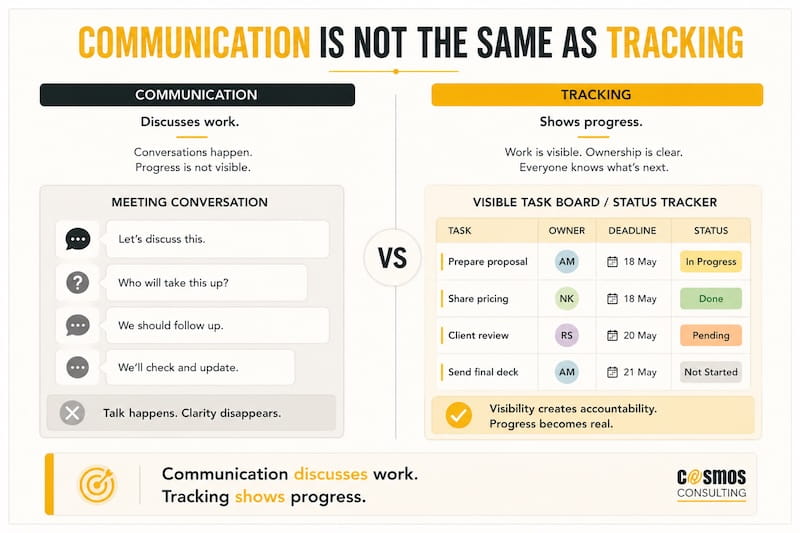
Tracking answers a completely different question.
“What changed?”
A conversation can be excellent while execution remains invisible.
Likewise, a business with excellent tracking often needs fewer meetings because everyone already knows the current status of work.
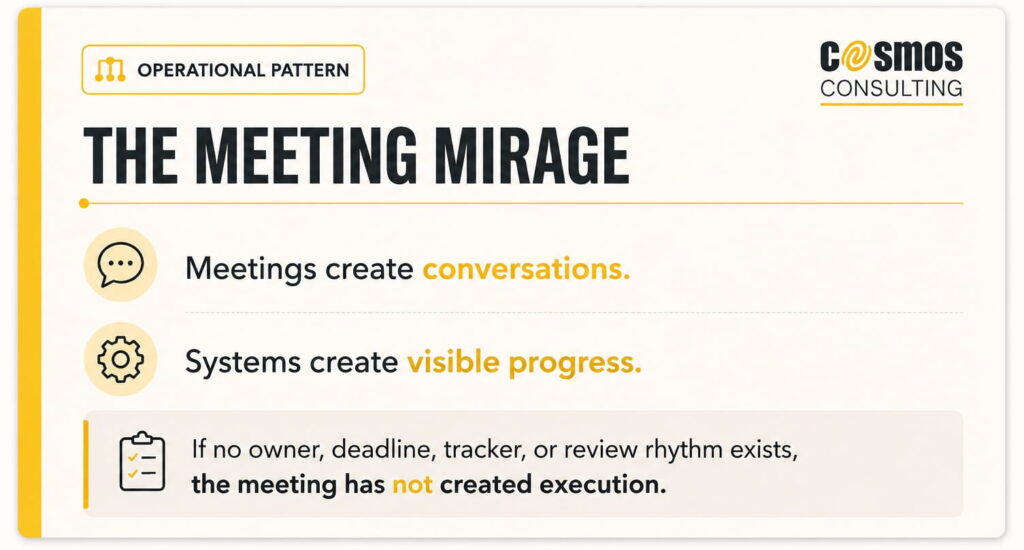
Meetings create alignment.
Systems create accountability.
The two should work together, but they should never replace each other.
A Simple Example Every SME Recognises
Imagine a weekly operations meeting.
Sales promises delivery by Friday.
Production agrees to start once materials arrive.
Procurement assumes approval has already been given.
Dispatch isn’t aware that the delivery date has changed.
Everyone leaves believing the plan is clear.
Thursday arrives.
Sales tells the customer everything is on schedule.
Procurement is still waiting for approval.
Production hasn’t started.
Dispatch has planned another shipment instead.
The founder calls another meeting.
The problem wasn’t poor communication.
Everyone attended the first meeting.
The problem was that nobody could see the work after the meeting ended.
What High-Visibility Businesses Do Differently
Businesses with strong operational systems don’t eliminate meetings.
They change the purpose of meetings.
Instead of using meetings to discover what is happening, they use them to review what is already visible.
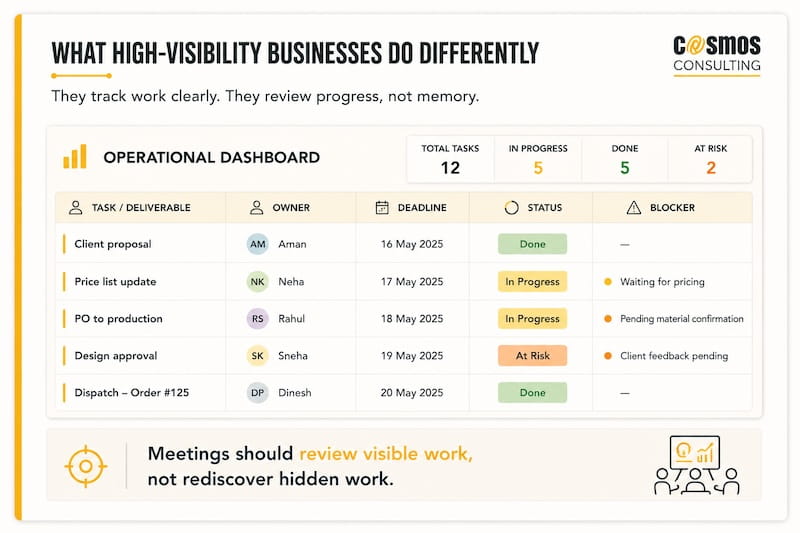
Before anyone enters the room, everyone already knows:
- who owns each task
- what is complete
- what is delayed
- what is blocked
- what requires a decision
The meeting becomes a place for decisions, priorities, and problem-solving.
Not status hunting.
This is where operational visibility begins to replace operational guesswork.
The COSMOS Perspective
Growing businesses don’t struggle because they have too few meetings.
They struggle because meetings become the only place where work can be seen.
A healthy business should be able to answer four questions at any moment.
- What is delayed?
- Who owns it?
- Why is it delayed?
- What happens next?
If those answers only become available after gathering everyone in a meeting room, the business isn’t running on systems.
It is running on conversations.
Within the COSMOS 4S Systems Framework™, this is primarily a Systems problem, not a communication problem.
The purpose of a business system is to make work visible before the meeting begins. Ownership, status, blockers and next actions should already be clear. The meeting simply reviews visible work, removes obstacles and makes decisions.
When meetings become the place where information is discovered instead of reviewed, the business has fallen into The Meeting Mirage.
Turn This Insight Into Action
Explore the COSMOS Vault for free checklists, starter kits, guides and ready reckoners designed to help you strengthen everyday SME operations.
Find practical tools for structure, SOPs, visibility, ownership, reporting and scale.
Final Thoughts
Meetings are valuable.
They help people make decisions, solve problems, and align priorities.
But meetings should never become your tracking system.
If your business only becomes visible when everyone is sitting around the same table, you are experiencing The Meeting Mirage.
The solution is not more meetings.
It is creating systems that keep work visible long after the meeting ends.
Related Reading
- Why SMEs Stay Stuck Even After Installing ERP Systems
- Dashboards Don’t Have to Be Ugly: Systems That Make Teams Self-Manage
- You Don’t Have a Team Problem. You Have a Clarity Problem.
- Track It to Trust It: The Role of Reporting in Scalable Teams
- SME Bottlenecks: Why It All Depends on You and How to Change That
Trademark Disclaimer
The COSMOS 4S SME Systems Framework™ and COSMOS 5R Leadership Framework™ are proprietary tools developed by Chhavi Jain, Director, Cosmos Consulting. These frameworks are unregistered trademarks (™) and may not be copied, reproduced, or repurposed without explicit written permission.
© Cosmos Consulting, 2026. All rights reserved.