Introduction: The ERP Was Installed. Chaos Stayed.
The software went live.
Dashboards appeared.
Reports started generating.
Teams attended training sessions.
Management announced a “digital transformation.”
And yet…
…Nothing really changed.
People still chased updates on WhatsApp. Approvals still depended on the founder.
Teams still argued over whose data was correct.
Customers still waited longer than they should.
And operations still slowed down every time pressure increased.
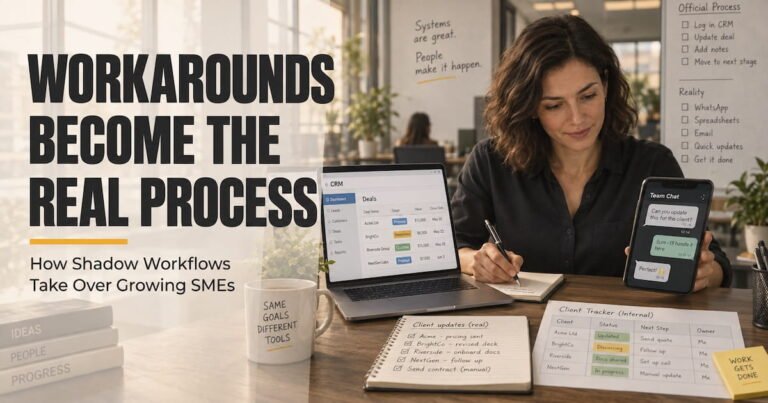
Over time, these workarounds can become a Shadow Workflow, where the official system exists but the real work happens elsewhere.
Want more SME cases like this?
Follow the COSMOS Case Library on YouTube.
This is one of the most common patterns we see inside SMEs. In fact, these are some of the most common SME ERP implementation challenges businesses face after going live.
The ERP gets installed. But the business itself never becomes operationally aligned.
Because software does not fix unclear ownership.
It does not fix broken workflows.
It does not fix inconsistent processes.
And it definitely does not create accountability automatically.
Most SMEs approach ERP implementation backwards.
They try to digitise confusion, instead of fixing how work moves inside the business first.
That is why many ERP systems become expensive reporting tools instead of operational control systems.
And this is exactly where most SME ERP implementation challenges begin.
The Real Problem Is Not the ERP
ERP systems are not the enemy.
In fact, a good ERP can become one of the strongest operational assets inside a growing business.
But only when the business itself is ready for structured execution.
Most SMEs underestimate this completely.
They believe the software itself will create discipline.
It won’t.
An ERP only reflects the operational reality underneath it.
- If the workflow is unclear… The ERP becomes confusing.
- If ownership is unclear… The ERP becomes incomplete.
- If approvals depend on verbal coordination… The ERP becomes bypassed.
- If departments work in silos… The ERP becomes fragmented.
The software simply exposes what already existed.
This is why many SME founders feel disappointed after ERP implementation. These SME ERP implementation challenges rarely begin inside the software itself.
They expected transformation.
What they got instead… was a digital version of the same chaos.
Why ERP Projects Fail Inside SMEs
ERP failures within large corporations and SMEs differ significantly. Most SME ERP implementation challenges begin long before the software goes live.
Large companies usually struggle with scale and complexity, while SMEs struggle with operational dependency. This distinction between technology implementation and operational readiness has also been discussed widely in management research, including by Harvard Business Review.
That difference matters.
In most SMEs:
- processes exist inside people’s heads,
- approvals depend on memory,
- teams rely on verbal instructions,
- roles overlap constantly,
- ownership changes depending on urgency,
- and workflows evolve informally over time.
The business may still function, but it functions through founder intervention.
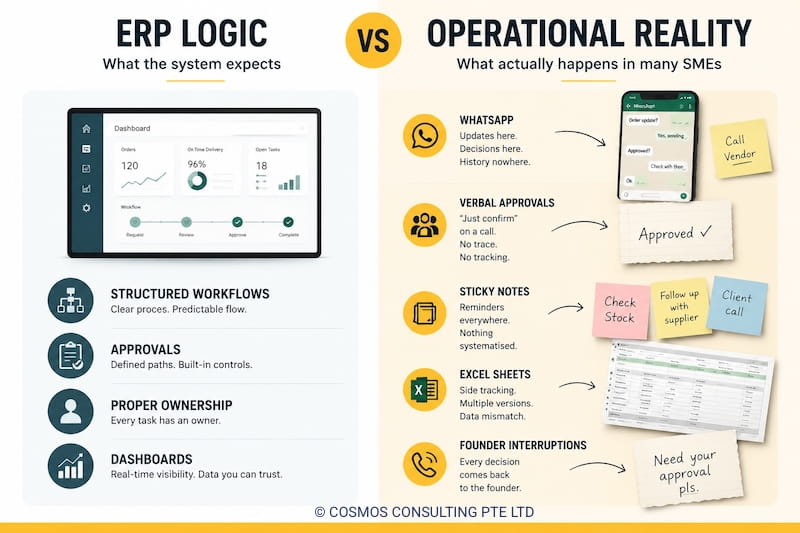
Once an ERP is introduced, all of these hidden gaps become visible immediately
Now the system expects:
- structured workflows,
- defined ownership,
- consistent data,
- predictable approvals,
- and process discipline.
But the organisation underneath may not actually operate that way.
This creates friction everywhere.
Teams begin resisting the ERP.
Not because they hate technology.
Because the business itself was never operationally aligned before implementation.
That is why many ERP systems inside SMEs slowly become “optional.”
• Data gets updated later
• Side Excel files appear everywhere
• Teams continue using WhatsApp for execution
• Workflows get bypassed “just this once”
And eventually, the ERP stops becoming the source of truth.
The Most Dangerous ERP Illusion
One of the biggest operational traps is believing that visibility equals control.
It doesn’t.
Many ERP dashboards look impressive.
But dashboards only show what people entered.
Not what is actually happening operationally.
This becomes extremely dangerous when leaders stop validating reality. Many SME ERP implementation challenges begin when dashboards replace operational verification.
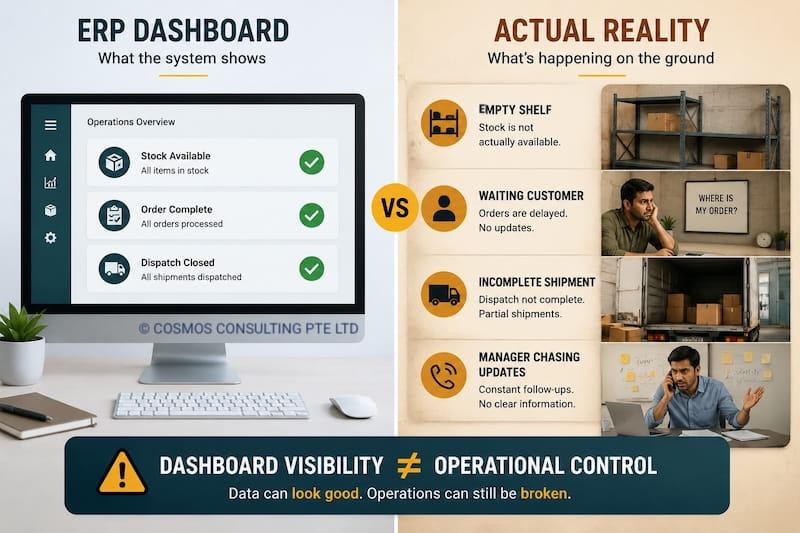
A system may show:
- stock available,
- orders completed,
- procurement closed,
- deliveries dispatched,
- invoices processed.
But operationally?
- Material may still be missing
- Customer may still be waiting
- Dispatch may still be incomplete
- Approval may still be stuck
They begin with operational clarity. This is why operational visibility matters far more than dashboard visibility.
A business does not become systemised because data exists.
It becomes systemised when reality and data remain aligned consistently.
ERP Systems Fail When Ownership Is Missing
This is where most implementation consultants underestimate SME dynamics.
Software adoption is not a technology problem.
It is an ownership problem.
Inside many SMEs, responsibilities are still blurred.
- Sales assumes Operations updated the customer
- Operations assumes Accounts released the invoice
- Accounts assumes Procurement confirmed the supplier
- Procurement assumes Production updated the timeline
Everyone touched the task.
But nobody owned the final outcome.
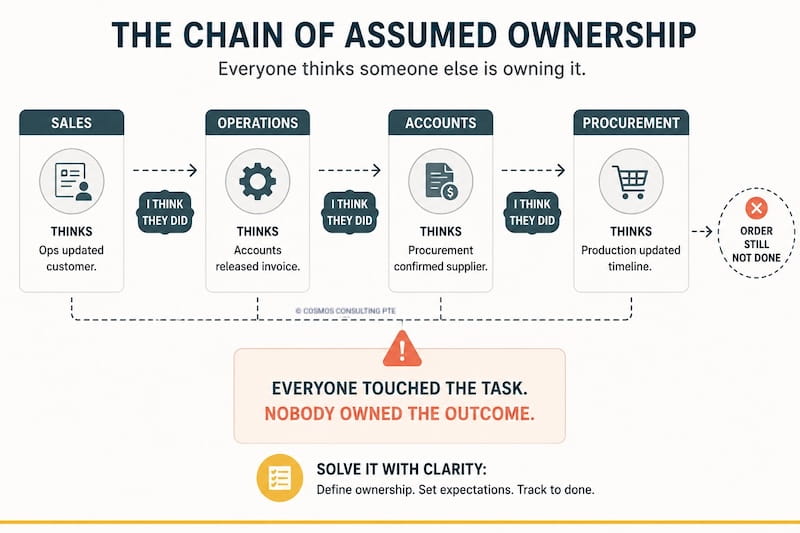
ERP systems struggle badly in environments like this. These are some of the most overlooked SME ERP implementation challenges during software adoption.
Because systems require visible accountability.
Not implied accountability.
This is exactly why structure becomes the foundation of scalable operations.
Without role clarity:
- workflows slow down,
- approvals multiply,
- escalation increases,
- reporting becomes unreliable,
- and founder dependency intensifies.
The ERP is blamed.
But the real issue is operational structure.
Why SMEs Keep Running Parallel Systems
One of the clearest warning signs of ERP failure is this:
The ERP exists.
But teams still depend on spreadsheets, WhatsApp, calls, and side trackers.
This usually happens when the ERP never becomes operationally useful to the people actually doing the work. And this is something many SMEs underestimate.
During ERP selection, businesses often evaluate large, ready-made systems packed with features, approvals, dashboards, and modules.
But operationally?
The team may not need all that complexity.
Inside SMEs, systems survive only when employees find them genuinely useful, fast, and practical to update.
That is why many SMEs eventually end up creating parallel systems.
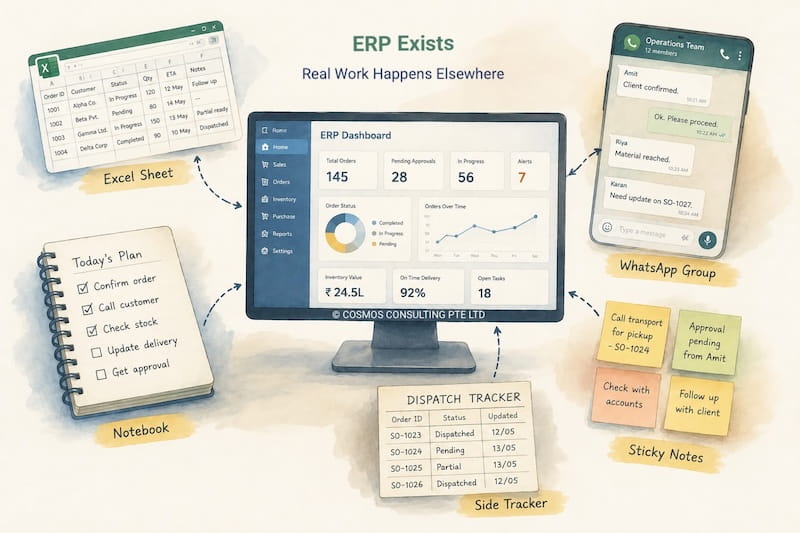
An Excel sheet for tracking. A WhatsApp group for escalation. A personal notebook for important follow-ups. A side tracker because the ERP feels too heavy for day-to-day execution.
We have seen this repeatedly in SME environments.
Some ERP modules work extremely well.
For example:
- order processing,
- workflow approvals,
- stock visibility,
- dispatch coordination,
- procurement tracking.
These work because the workflow is structured and predictable.
But modules involving constantly changing human activity often struggle.
For example:
- sales follow-ups,
- enquiry progression,
- project updates,
- daily activity tracking.
Not because the ERP is bad.
Because these workflows evolve too dynamically for rigid updates.
Teams then start maintaining their own systems outside the ERP. This is one of the most common SME ERP implementation challenges after software rollout.
And once that happens, the ERP stops becoming the operational source of truth.
The problem is not software.
The problem is forcing operational behaviour into systems that do not match how teams actually work.
That is why SME ERP implementation must balance:
- structure,
- usability,
- visibility,
- and operational reality.
Not just features. Which is also why regular review becomes critical.
Even good systems drift over time.
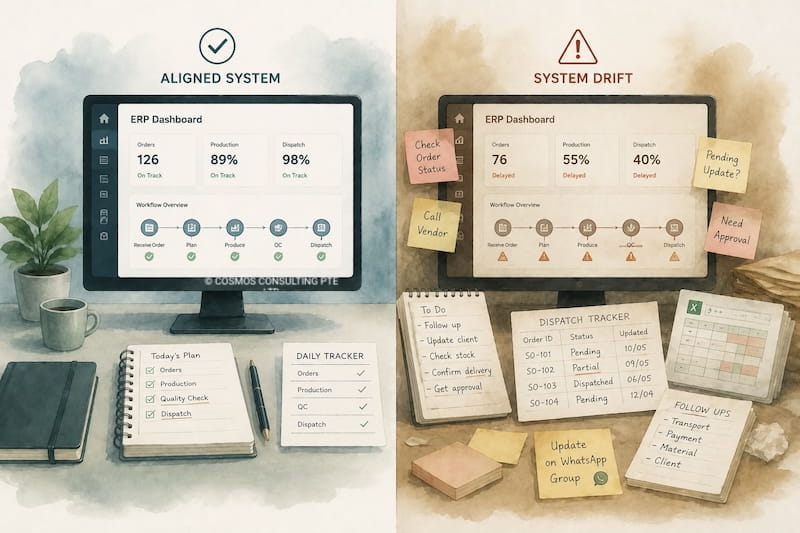
Processes evolve. Teams change. Priorities shift.
And without regular operational review, even hardworking teams eventually stop using systems consistently.
👉 This is where the COSMOS 5R Leadership Framework™ becomes critical.
Because systems only remain useful when leaders continuously:
- review
- refine
- reassign
- report
- and reinforce operational behaviour
Otherwise, the ERP slowly becomes another abandoned layer inside the business.
The COSMOS View: ERP Is Step 3, Not Step 1
This is where many SMEs make the wrong investment sequence.
They start with tools.
But scalable operations do not begin with software.
That is why many SME ERP implementation projects fail before the software even goes live.
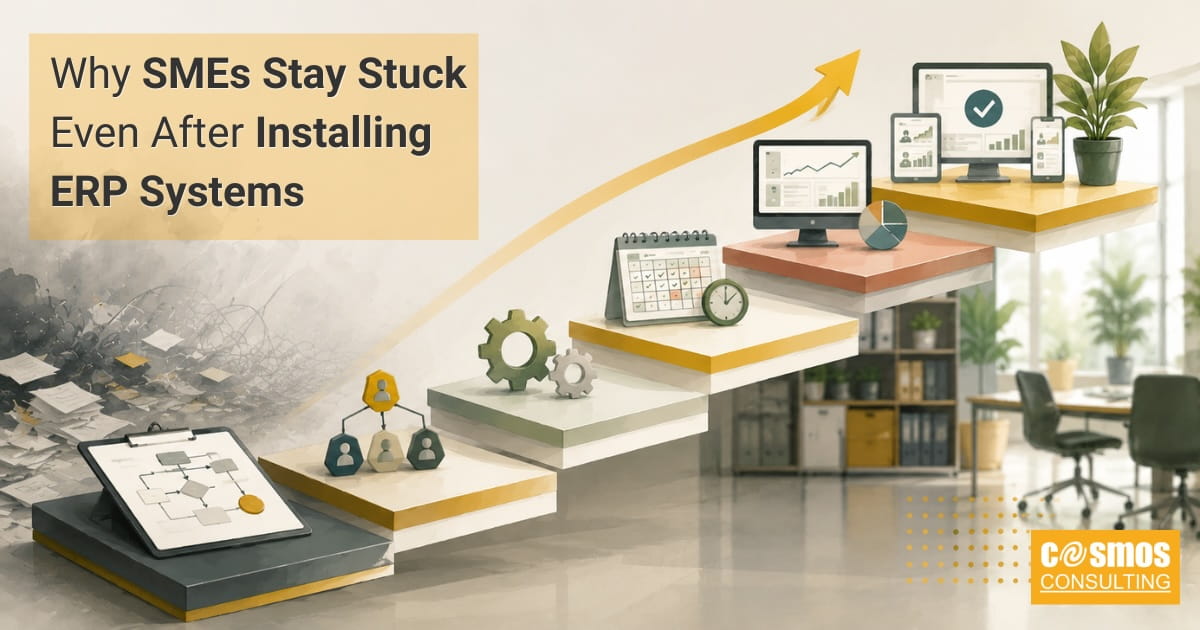
Inside the COSMOS 4S SME Systems Framework™, ERP implementation belongs inside the Systems stage.
Not before it.
The sequence matters.
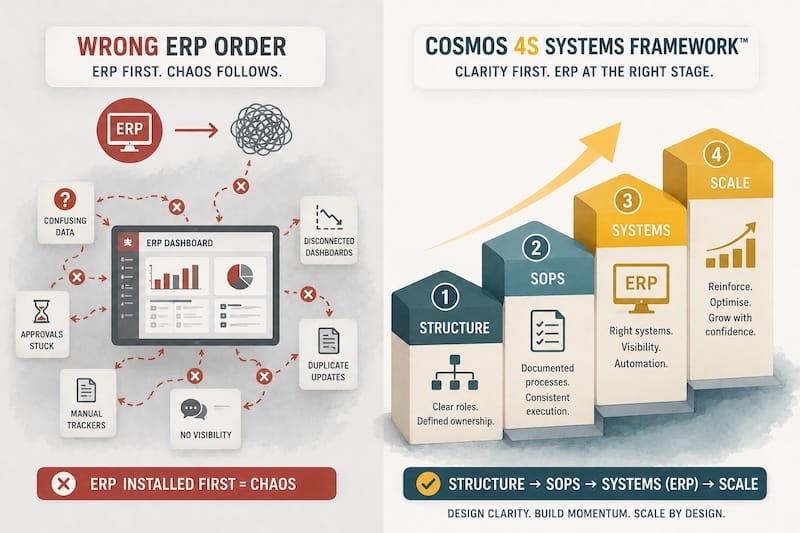
Step 1: Structure
Clarify:
- roles,
- ownership,
- workflows,
- approval paths,
- and operational boundaries.
Step 2: SOPs
Document how work actually moves.
Not theoretically.
Operationally.
Including:
- escalation flow,
- handoffs,
- approvals,
- dependencies,
- and exceptions.
Step 3: Systems
Only now should technology become the operational layer.
Because now:
- workflows exist,
- ownership exists,
- approvals exist,
- visibility exists,
- and execution logic exists.
The ERP is no longer trying to create structure.
It is a reinforcing structure that already exists.
Step 4: Scale
Now the business can actually scale without collapsing into confusion.
Because growth no longer depends entirely on memory, verbal coordination, or founder intervention.
A Real SME Pattern We See Repeatedly
An SME installs an ERP expecting faster execution.
But nobody clearly defines:
- who updates customer timelines,
- who closes procurement loops,
- who validates stock accuracy,
- who owns final dispatch confirmation,
- or who escalates delays.
The ERP technically works. But many SME ERP implementation projects fail operationally long before the software fails technically. But decisions still move through people manually.
So every urgent order becomes a coordination crisis.
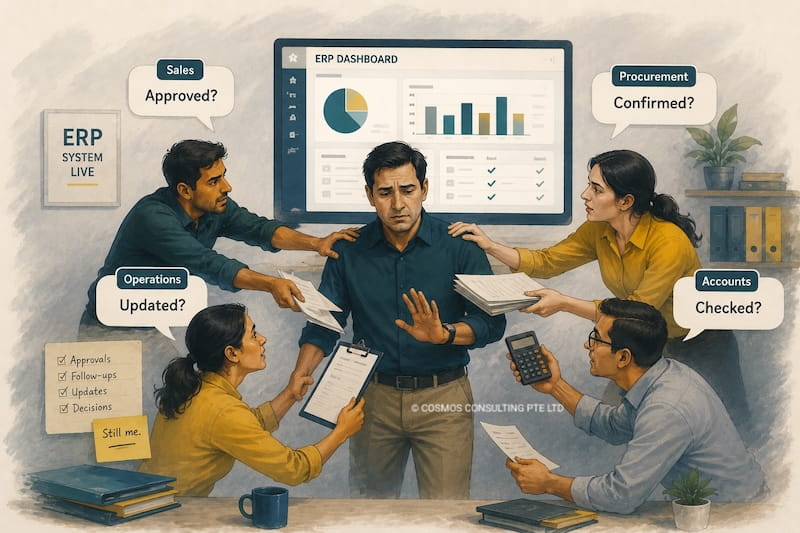
The founder gets pulled back into approvals. Teams wait for confirmation.
And customers experience delays despite “having a system.”
This is not a software failure.
It is an operational design failure.
What SMEs Should Do Before Installing an ERP
Before selecting software, SMEs should first stabilise how work actually moves inside the business. That is the missing step in many SME ERP implementation strategies.
Because ERP systems amplify operational behaviour.
They do not create it.
That means businesses should first focus on operational readiness before technology selection.
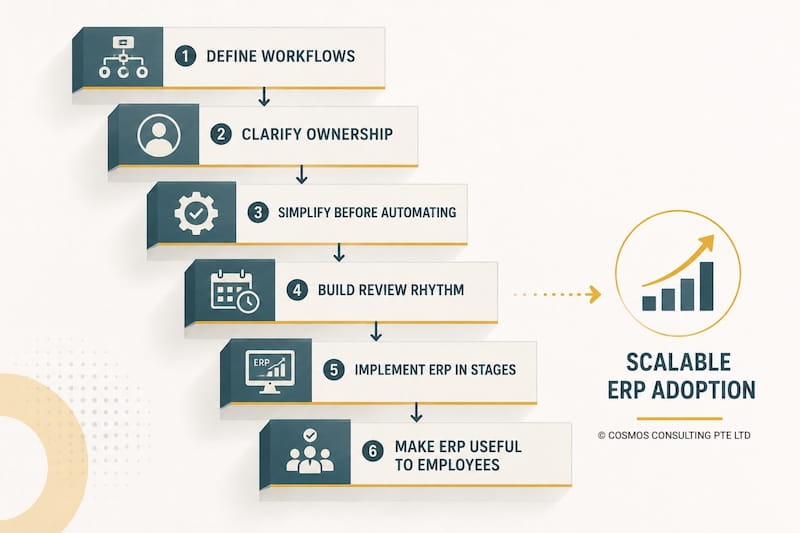
1. Define Workflows Clearly
Can work move consistently without verbal clarification?
Or does every task still depend on “checking with someone”?
If workflows are unclear before ERP implementation, the confusion simply becomes digital.
2. Clarify Ownership
Can every operational outcome be traced to a clear owner?
Not department.
Owner.
Because systems fail quickly when accountability stays blurred.
3. Simplify Before You Automate
Many SMEs try to automate broken processes.
This usually creates more complexity.
The smarter approach is:
- simplify first,
- remove unnecessary approvals,
- reduce duplicate tracking,
- then digitise.
Simple systems are adopted faster.
Complex systems are bypassed faster.
4. Build a Review Rhythm
This is one of the most overlooked parts of ERP success.
Even well-designed systems fail when nobody reviews them consistently.
Because operational behaviour drifts.
Teams stop updating properly. Processes evolve informally. Side trackers appear.
That is why successful SME systems require regular leadership review.
Not micromanagement.
Review.
5. Implement ERP in Stages
SMEs do not need a massive digital transformation overnight.
The strongest ERP implementations usually begin with:
- order processing,
- procurement,
- dispatch,
- stock visibility,
- approval flow.
Then expand gradually.
Trying to digitise everything immediately usually overwhelms the team.
And overwhelmed teams stop trusting systems quickly.
6. Make the ERP Useful to Employees
This matters more than most businesses realise.
Employees consistently use systems that:
- reduce confusion,
- reduce follow-ups,
- reduce duplicate work,
- and make execution easier.
If the ERP only feels like reporting work for management, people stop updating it properly.
And once system trust breaks, visibility breaks too.
If these foundations are weak… The ERP will struggle too.
The Goal Is Not Digitalisation
This is important.
The goal of an ERP is not simply to digitise work.
The real goal is operational predictability.
The business should become:
- easier to manage,
- easier to track,
- easier to scale,
- and less dependent on constant founder intervention.
Technology is only valuable when it strengthens operational rhythm.
Otherwise… the business simply becomes digitally overwhelmed instead of operationally aligned.
Final Thought
An ERP system cannot become the brain of a business that still runs on memory.
And software cannot create accountability where ownership never existed.
The businesses that benefit most from ERP systems are not the ones with the biggest budgets.
They are the ones with the clearest operational foundations.
Because scalable systems are never created by software alone.
They are created when:
- structure becomes visible,
- workflows become repeatable,
- ownership becomes clear,
- and leadership stops operating reactively.
That is when systems finally begin working.
Not just technically.
Operationally.
Strengthen the System Behind the Software
Explore the COSMOS Vault for practical guides and ready reckoners that can help you clarify processes, prepare for system changes and improve operational visibility.
Related Blogs
- 👉 COSMOS 4S SME Systems Framework™
- 👉 SOPs Are Boring? Think Again. They Could Save Your Business
- 👉 Dashboards Don’t Have to Be Ugly – Systems That Make Teams Self-Manage
- 👉 Why Work Slows Down as You Grow (Even When You Hire More People)
- 👉 Operational Visibility for SMEs
Final CTA
If your ERP system still feels disconnected from how work actually moves inside the business…
… the issue may not be the software.
It may be the operational structure underneath it.
That is exactly what the COSMOS Frameworks are designed to solve.
👉 Explore the COSMOS 4S SME Systems Framework™
👉 Explore the COSMOS 5R Leadership Framework™
Trademark Disclaimer
The COSMOS 4S SME Systems Framework™ and COSMOS 5R Leadership Framework™ are proprietary tools developed by Chhavi Jain, Director, Cosmos Consulting. These frameworks are unregistered trademarks (™) and may not be copied, reproduced, or repurposed without explicit written permission.
© Cosmos Consulting, 2026. All rights reserved.