
Most founders facing team problems in small business think they have a people issue. They usually have a clarity problem.
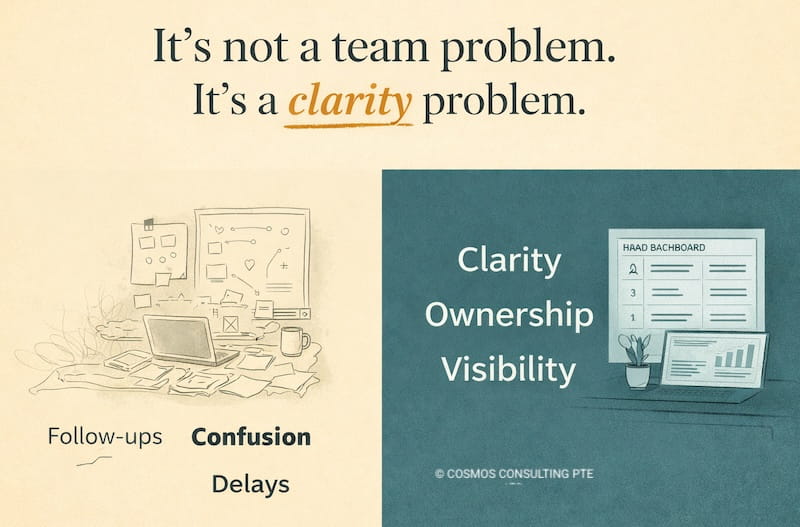
The symptoms look like people issues on the surface. Tasks stall. Follow-ups never end. The same instructions get repeated. Decisions keep climbing back to the founder.
So the conclusion feels obvious: the team is not stepping up.
But in many SMEs, that is the wrong diagnosis.
The real issue is that the work is still unclear, ownership is still blurred, and too much operational logic still lives inside one person’s head.
Most team problems in small business are not caused by capability gaps, but by unclear structure and systems.
Why Team Problems in Small Business Are Often Misdiagnosed
Picture this…
This exact situation is more common than you think.
Here is a quick story that shows how this plays out inside real businesses:
What looks like a team problem is often a clarity and decision design problem. If these operating patterns feel familiar, then you can explore the COSMOS Case Library on Youtube, where we investigate the everyday SME breakdowns and reveal the hidden system gap behind them.
A sales executive is standing outside the founder’s office, waiting to get a quotation approved. The numbers are ready. The customer is waiting. The urgency is clear.
But nobody sends it.
Because only the founder knows what margin is “acceptable.”
This misdiagnosis is common for a reason.
Founders are usually closest to the mess. They see the delays, the dropped balls, the repeat mistakes, and the endless dependency. They do not see “lack of clarity” first. They see the symptoms it creates.
Someone forgot to follow up.
A staff member waited instead of acting.
A task came back incomplete.
A customer issue sat too long.
After a while, it starts to feel personal.
Why do I have to chase everything?
Why does nobody take ownership?
Why can’t they think ahead?
Fair questions. But not always the right ones.
In many cases, the team is not resisting ownership. They are operating inside vague roles, inconsistent processes, and unclear decision boundaries. What looks like reluctance is often uncertainty.
And uncertainty, in business, does not look polite. It looks like weak execution.
What Looks Like a Team Problem Is Usually a Clarity Gap
In my experience, most SME execution issues come back to four gaps.
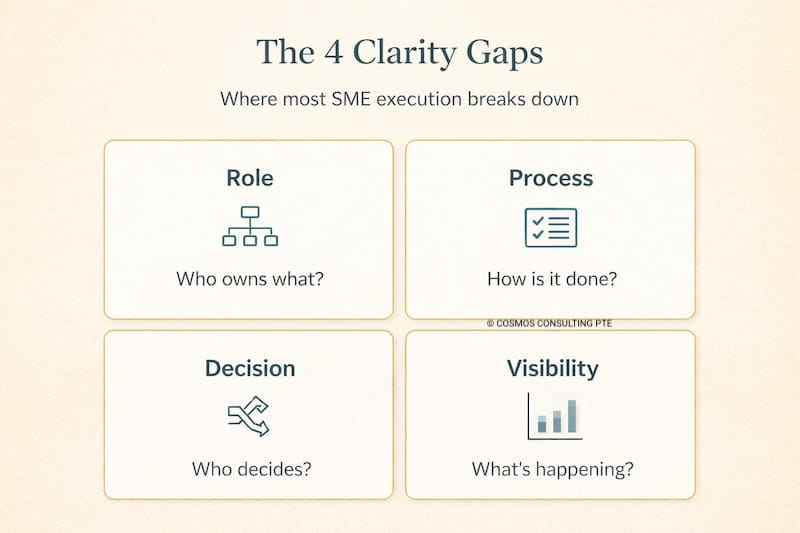
1. Role clarity is weak
People are busy, but ownership is fuzzy.
Two people assume the other person is handling it. One department starts the work, but nobody is fully responsible for closing it.
👉 Cross-Department Execution Breakdowns
2. Process clarity is weak
The task exists, but the method is unstable.
One person follows one method. Another improvises. A third asks the founder every time because the “correct way” was never fully documented.
👉 Why SOPs matter in Small Businesses?
3. Decision clarity is weak
Teams do not know what they are allowed to decide.
They escalate. They hesitate. Or they guess.
4. Visibility is weak
Nobody can clearly see what is moving, stuck, overdue, or off track.
So the founder becomes the dashboard.
👉 Operational Metrics and Visibility
This is where basic operational visibility starts becoming critical. Even simple frameworks like KPI tracking or performance dashboards (as explained in resources like Investopedia’s guide to KPIs) can change how teams function.
What Missing Clarity Does to a Business
When clarity is weak, a very specific culture starts to form.
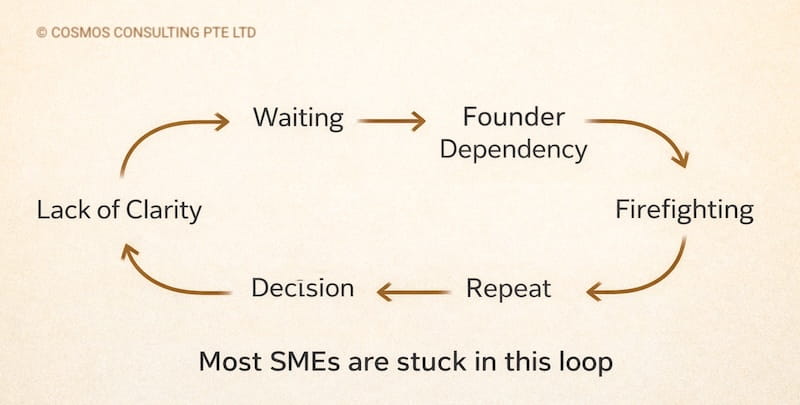
People wait.
Not always because they are lazy. Often because acting feels risky and accountability is vague.
Over time, this creates four patterns:
- Waiting culture
- Founder dependency
- Inconsistent execution
- Permanent firefighting
The founder becomes the system.
And that does not scale.
Why Pushing Harder Makes It Worse
More reminders do not create clarity.
More checking does not create ownership.
More involvement does not create independence.
It creates the opposite.
The more the founder steps in, the more the team steps back.
Not by choice.
By design.
What Changes When Clarity Is Built Into the Work
Businesses do not become less dependent by telling people to “take ownership.”
They become less dependent when clarity is built into how work runs.
This is where the COSMOS 4S Systems Framework™ comes in.
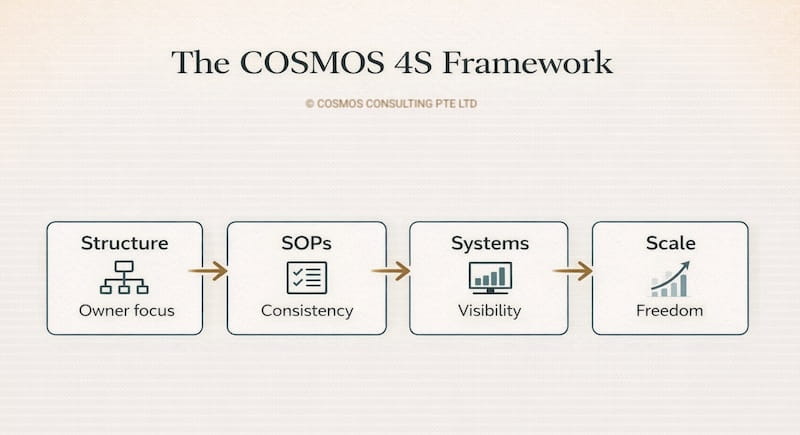
- Structure → ownership becomes visible
- SOPs → work becomes repeatable
- Systems → progress becomes trackable
- Scale → becomes possible without chaos
When clarity improves:
- People stop guessing
- Decisions speed up
- Founder involvement reduces
- Ownership starts showing up naturally
A Simple SME Example
A founder complains that the team cannot send quotations without checking everything with him.
He calls it a confidence issue.
But the real issue is different.
Pricing logic is not documented. Approval limits are unclear. Exceptions are handled case by case.
So the team keeps coming back.
Once pricing rules are defined and decision boundaries are clear, something changes.
The team moves faster.
The founder is no longer involved in everything.
Ownership appears.
Not because people changed.
Because clarity did.
The Real Fix
If your team cannot move without you, the issue is not just capability.
The business still depends too much on invisible logic.
And invisible logic does not scale.
You do not fix teams by pushing them harder.
You fix them by making the work clearer.
If this resonates, explore the COSMOS 4S Systems Framework™ and related resources on operational clarity, SOPs, and systems thinking.
That is where the real shift begins.
Turn This Insight Into Action
Explore the COSMOS Vault for free checklists, starter kits, guides and ready reckoners designed to help you strengthen everyday SME operations.
Find practical tools for structure, SOPs, visibility, ownership, reporting and scale.



This is such an important perspective. Many business owners immediately assume they have a people problem when the real challenge is often unclear expectations, processes, or ownership. A team can only perform well when they understand what success looks like and what decisions they are empowered to make. Great insights!
Thank you Shiva. That distinction is exactly what I wanted the article to surface. What looks like a people problem is often a system problem underneath, especially when expectations, ownership, and decision boundaries are unclear. Once those are made visible, team performance usually becomes much easier to improve.