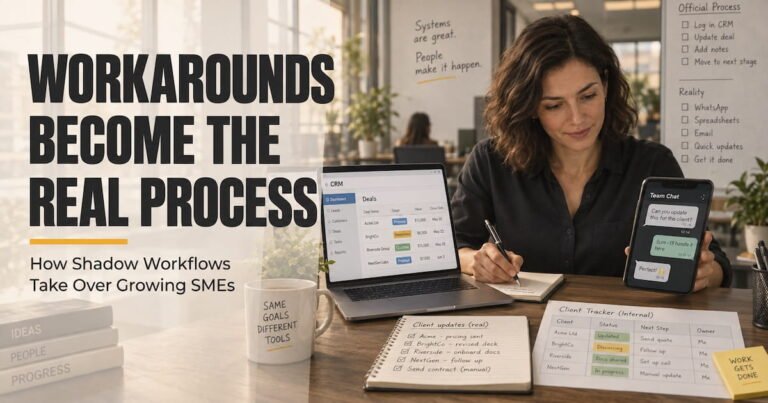

Most SMEs don’t lose control because work isn’t happening.
They lose control because they can’t see what is moving.
Updates come late.
Follow-ups increase.
Leaders keep asking the same questions.
👉 Not because teams are careless.
But because progress is invisible by design.
This blog covers the reporting system for SMEs: REPORT — Step 4 of the COSMOS 5R Leadership Framework™.
The step where work stops depending on follow-ups…
and starts becoming visible by design.
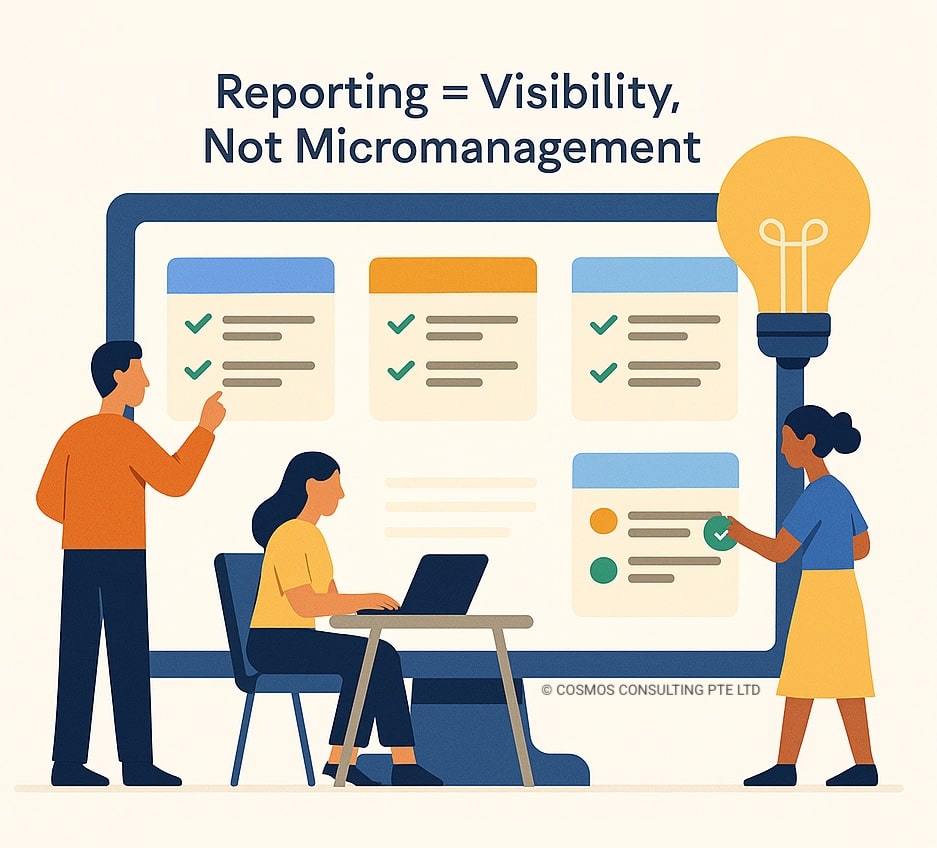
SME founders trying to delegate, but are stuck in endless follow-ups.
Without reporting:
Leaders assume progress.
Teams assume someone else is tracking it.And work quietly slows down.
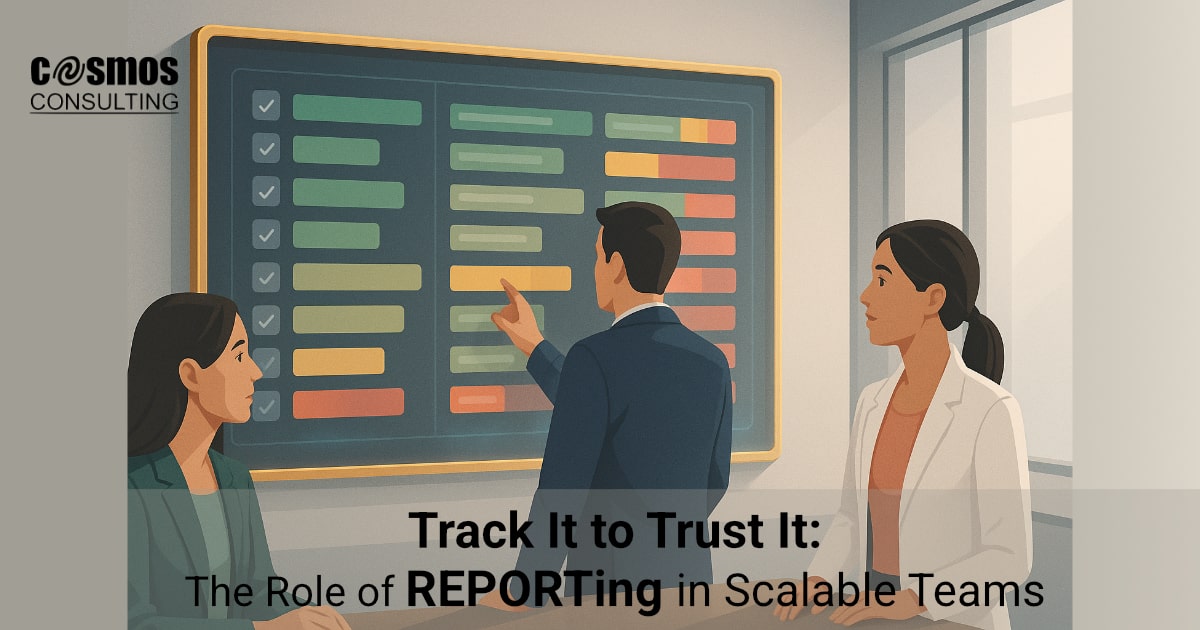
Progress reporting in small business is where true visibility starts…
… It’s about creating shared visibility, so that everyone knows what’s on track, what’s delayed, and where support is needed.
🧭 Step 4: Report Progress Regularly
This is the fourth step in the 5R SME Leadership Framework:
- ✅ Review what is stuck
- ✅ Record what should happen
- ✅ Reassign roles with clarity
- 🔶 Report progress regularly ← You are here
- ⏭️ Reinforce what works consistently
If Reassign creates ownership, then Report creates accountability.
At this point in the system:
- Review has surfaced what’s stuck
- Record has captured key decisions
- Reassign has clarified ownership
👉 Now the problem changes.
Work is happening. But no one can see if it is moving.
That is where REPORT comes in.
💡 This is the fourth step of the COSMOS 5R Leadership Framework™, a practical approach to leading systems without doing everything yourself.

Step back and assess what’s broken

Turn fixes into documented process

Shift clear ownership to the right roles

Create visibility without micromanaging
Make it stick with habits, not hope
🤔 Why Reporting Gets Overlooked in SMEs
In small lean teams, reporting often breaks down due to:
- Updates shared verbally or over WhatsApp.
- Progress buried inside one person’s inbox or memory.
- No routine to surface delays until they become problems.
This leads to the founder constantly asking:
“Did that get done?”
And the team waiting:
“No one followed up, so I assumed…”
This isn’t a team failure.
It is a visibility system failure.
📌 This is where most SMEs stop at systems…
But visibility still breaks.
🎯 Why Every SME Needs a Reporting System?
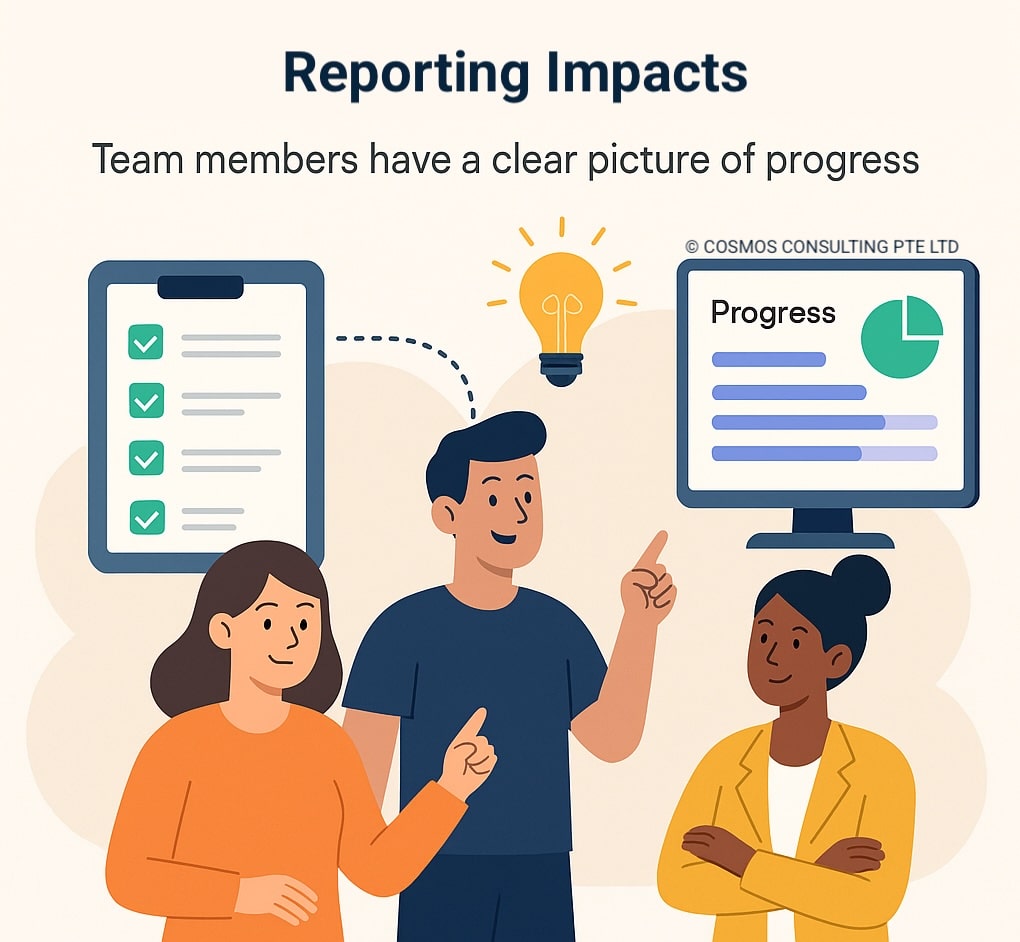
Systems show what exists.
Reporting shows what is moving.
And when you track it consistently, it becomes measurable.
👉 That is what creates decision flow.
This is where the COSMOS 4S Systems Framework™ connects.
Systems create structure. Reporting creates visibility.
👉 Without systems, there is nothing to report.
That difference matters.
Because most SMEs don’t fail due to lack of systems.
They slow down because movement is invisible.
Reporting is not a compliance tool.
👉 It is a visibility system that builds trust.
Without reporting:
- Leaders assume progress.
- Teams assume someone else is tracking it.
- And work quietly slows down.
At COSMOS, we say:
“If you can’t see it, you can’t scale it.”
That is the real purpose of Step 4.
🔁 How to Build a Simple Reporting System for SMEs
By this stage, one thing is clear:
You don’t need complex tools.
You need clarity in what gets reported.
And consistency in how it shows up.
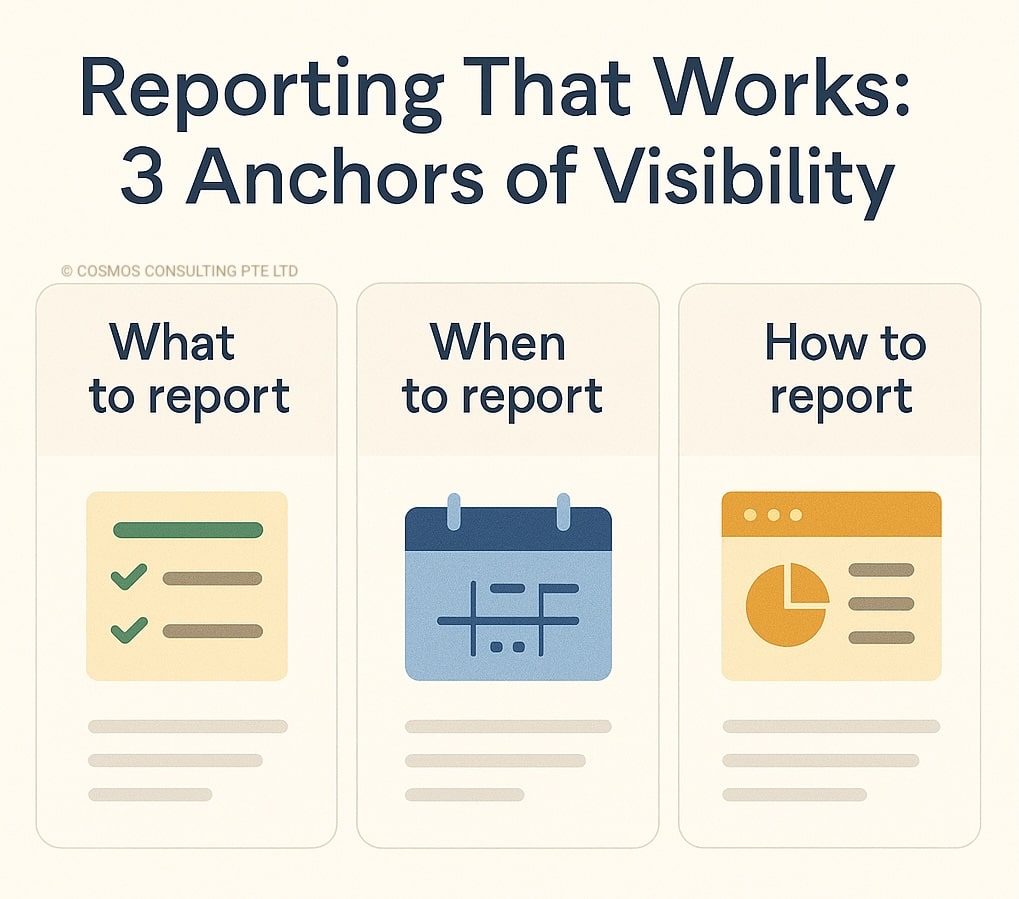
What you DO NEED are three things: Clarity, rhythm, and consistency.
Here’s how to build them.
1️⃣ Define What Should Be Reported
Too often, team members aren’t sure what counts as a “report.”
Make it clear:
- Is it a task update?
- A red flag?
- A delivery status?
Use the clarity you created in Step 2: Record what should happen to set reporting expectations.
🎯 Keep it simple: 1 metric, 1 note, 1 next step.
2️⃣ Set a Reporting Rhythm
No rhythm = no visibility.
Examples:
- A Friday update on delivery status.
- A Monday check-in call on top priorities.
- A monthly dashboard shared with leadership.
Small rhythm. Big payoff.
Your job as the founder is not to follow up.
👉 It is to design a system where updates move without you.
3️⃣ Use Lightweight Tools
You don’t need a full ERP system to build visibility.
Start with:
- A Google Sheet tracker
- A Kanban board (like Trello)
- A shared status doc
Tools don’t create clarity… consistency does.
But even a simple dashboard, updated weekly, shifts your team from reporting when chased to reporting by design.
👉Read: Dashboards Don’t Have to Be Ugly
🛠️ Reporting in Action: A Before-After View
Let us say Neha handles warehouse dispatches.
And you still don’t know what’s delayed.
Before:
- Updates come only when you chase.
- Delays are discovered after a customer calls.
- You’re stuck chasing every shipment.
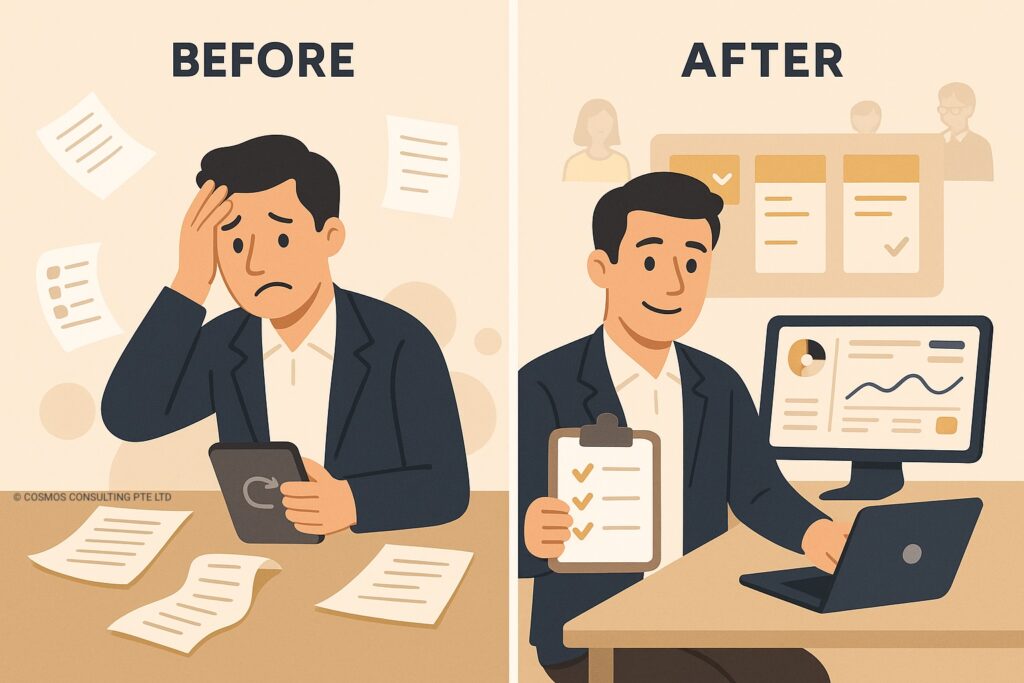
After:
- Neha updates the delivery tracker every Friday.
- Delays are flagged automatically.
- The team sees issues before you do.
That is not reporting for reporting’s sake.
👉 That is visibility that moves decisions.
🟡 See More COSMOS Cases
Did these operating patterns feel familiar?
Explore the COSMOS Case Library on YouTube, where everyday SME breakdowns are investigated to reveal the hidden system gap behind them.
🔄 Reporting Without Ownership Still Fails
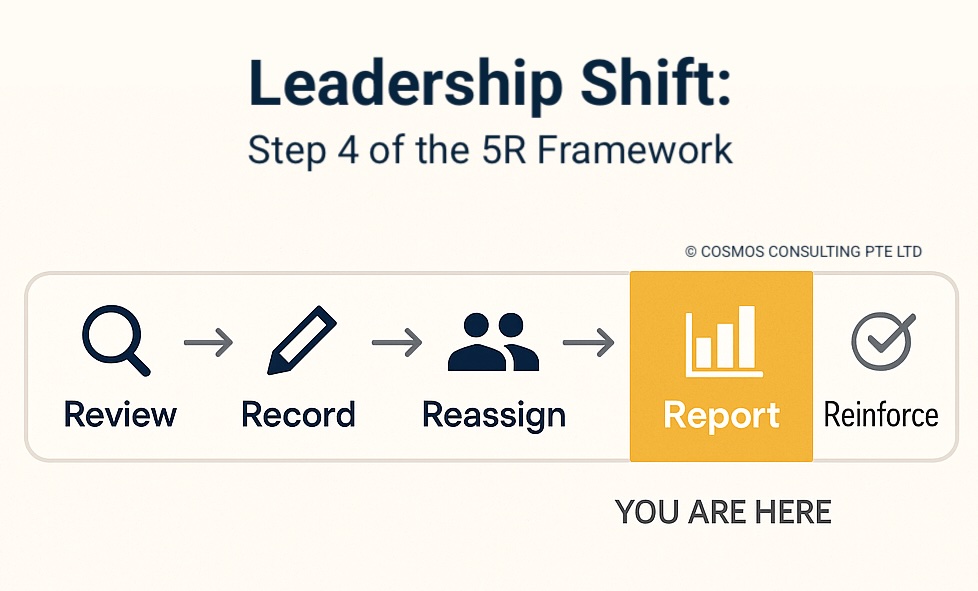
Step 4 only works if the first 3 are in place:
| Step | Focus | Outcome |
|---|---|---|
| 1️⃣ Review | Spot what is stuck | Understand breakdowns |
| 2️⃣ Record | Define ideal workflows | Establish what should happen |
| 3️⃣ Reassign | Assign true ownership | Clarify accountability |
| 4️⃣ Report | Make work visible | Make progress visible, reduce follow-up |
| 5️⃣ Reinforce | Build the new normal | Strengthen and sustain changes |
Each step fixes what the previous one couldn’t.
Without Reassign, ownership stays unclear.
Without Report, decisions still don’t move.
❓Frequently Asked Questions
🚀 Final Thoughts: Visibility Is the Shortcut to Trust
When progress is invisible, trust erodes.
When updates are visible, trust compounds.
Reporting doesn’t need to be perfect.
👉 It needs to be predictable enough to trust.
And when your team starts reporting without being asked—
That is when you know your leadership is scaling.
This is Step 4.
👉 Without reporting, decisions stay invisible.
Next comes:
👉 REINFORCE: where consistent behaviour turns into a system
Explore the full COSMOS 5R Leadership Framework™ here →
📥 Take the Next Step
Build your team’s trust with clear progress reporting.
Is Too Much Work Still Returning to You?
Take the free COSMOS 5R Leadership Self-Check to identify where Review, Record, Reassign, Report or Reinforce needs strengthening.
💡 We use MailerLite to power our lead magnets and client communications. It’s beginner-friendly, powerful, and highly affordable for SMEs
Related Posts
- How the 5R Framework Strengthens SME Leadership Without Burnout or Bottlenecks
- Start With Truth: Why Reviewing Bottlenecks Is Your First Leadership Move
- Record the Fix: How SMEs Can Stop Relying on Verbal Instructions
- Don’t Just Delegate—Reassign With Ownership
- Make It Stick: How SMEs Can Reinforce Systems Without Micromanaging
💬 Your Turn
What is one thing your team should be reporting, but isn’t yet?
Drop it in the comments – I reply to everyone.
🛡 Trademark Notice
The COSMOS 4S Systems Framework™ and COSMOS 5R Leadership Framework™ are proprietary tools developed by Chhavi Jain, Director, Cosmos Consulting. These frameworks are unregistered trademarks (™) and may not be copied, reproduced, or repurposed without explicit written permission.
© Cosmos Consulting, 2025. All rights reserved.