Sales confirms a delivery date that the customer is happy with.
Operations looks at the production schedule and realises the timeline is unrealistic.
Finance reviews the quotation and quietly questions the margin.
A quick internal discussion follows.
→ Sales explains the client pressure.
→ Operations explain capacity.
→ Finance explains the numbers.
The founder steps in to “align everyone”. In reality, the founder is translating between departments, looking at the same job through different lenses.
→ Sales is optimising for the client. Operations is optimising for feasibility. Finance is optimising for margin.
Individually, everyone is doing their job correctly…
…but collectively, the business has lost a shared operational picture.
This is where cross-department communication in SMEs begins to break down…
not because people stop trying, but because growth quietly introduces gaps between functions that were never structurally designed to work together at scale.
Why Cross-Department Gaps Form
What are cross-department gaps in SMEs?
Cross-department gaps in SMEs occur when work moves between departments without clear ownership, shared visibility, or defined workflows. As businesses grow, informal coordination breaks down, creating misalignment between sales, operations, and finance.
Cross-department gaps in SMEs usually appear when:
- Ownership across departments is unclear
- Operational visibility is limited
- Workflows between teams are undefined
- Decisions depend on verbal coordination
In the early stage of a business, coordination is informal.
Everyone shares the same context. Decisions happen quickly. The founder carries most of the operational picture.
Growth changes that dynamic.
More clients. More projects. More work is happening in parallel.
Departments begin specialising. Sales focuses on the pipeline, operations on delivery, and finance on numbers.
Each function becomes sharper… but the connective structure between them often remains informal.
When alignment still relies on verbal updates and assumptions, gaps begin to appear.
I call this Structural Drift.
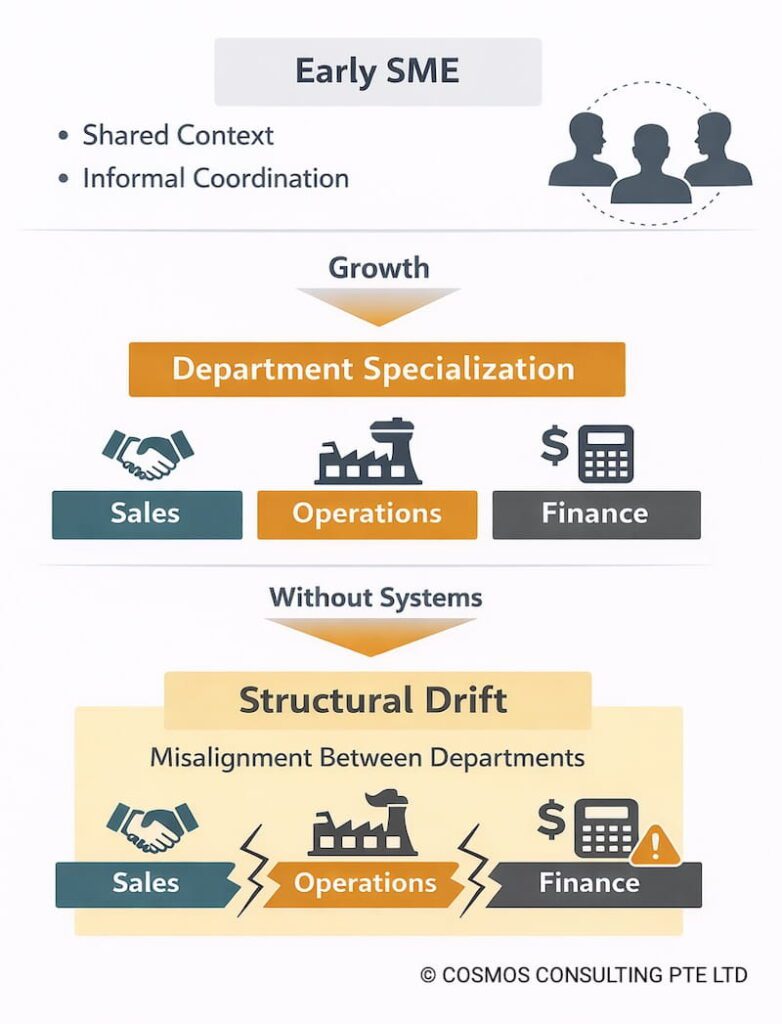
Structural Drift happens when business complexity grows faster than the systems designed to coordinate it.
At first the founder fills the gap, translating between departments. But as activity increases, the volume of translation grows. These gaps slowly turn the founder into the coordination hub between departments.
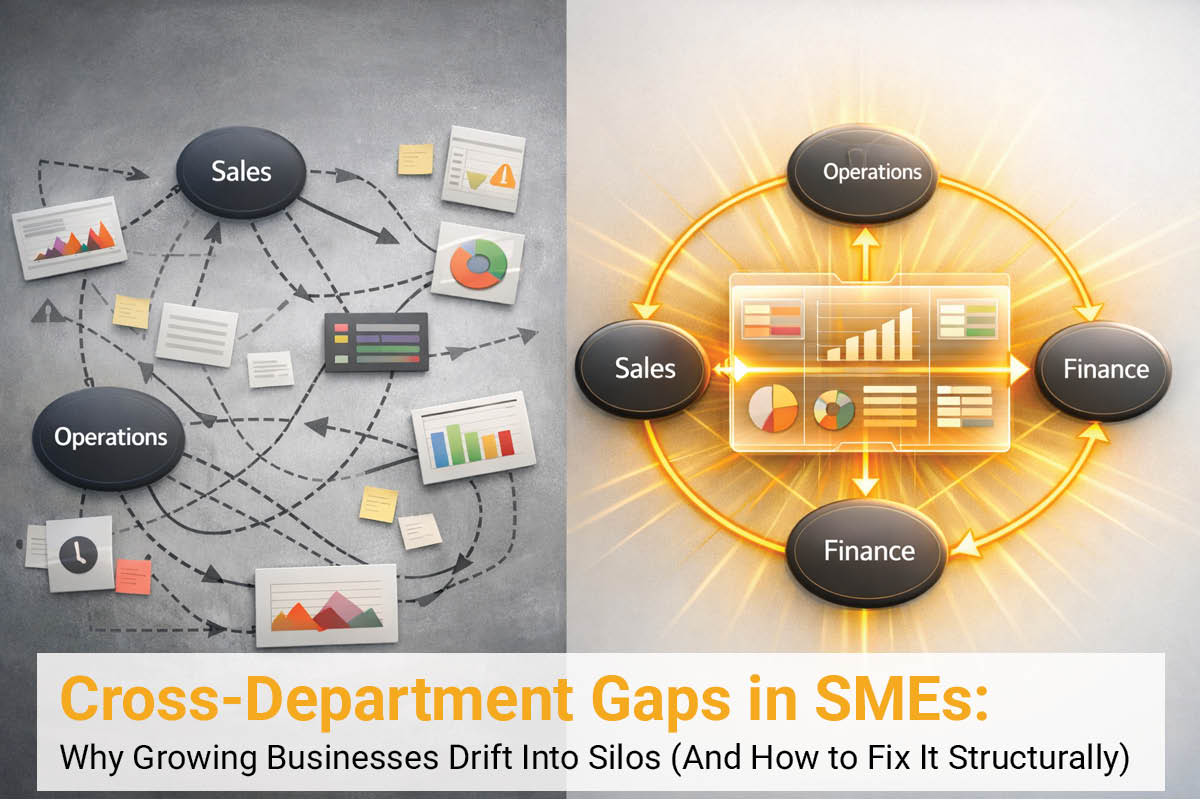
That is when departmental silos in SMEs begin to emerge…
…not through conflict, but through drift.
Over time, this creates hidden leadership bottlenecks that slow decision-making and execution. (Read more about this pattern in SME Bottlenecks: Why It All Depends on You—and How to Change That.)
The Hidden Cost of Silos
Return to the earlier situation.
Sales promised a timeline.
Operations saw the capacity problem.
Finance questioned the margin.
Each department was working with different pieces of the same reality.
No one had the complete operational picture.
This is how cross-functional gaps in SMEs quietly create cost.
1. Duplicate Work
Sales revises the quotation when delivery assumptions change. Operations double-checks capacity. Finance recalculates the margin.
Everyone is working… but not from the same operational truth.
2. Delayed Decisions
When ownership across departments is unclear, decisions slow down.
Sales waits for operations. Operations waits for finance. Finance waits for confirmation.
A ten-minute alignment becomes a two-day loop.
3. Founder Overload
Because departments cannot see each other’s constraints, disagreements escalate upwards.
The founder becomes the integration layer of the business.
4. Inter-Department Blame
Over time, each department interprets problems through its own lens.
Sales believes operations is slow. Operations believes sales overpromises. Finance believes both ignore margin pressure.
Operational silos in SMEs are rarely people problems…
…They are system design problems.
When structure does not evolve with complexity, small gaps quietly expand into operational friction.
Research from Harvard Business Review shows that cross-silo collaboration becomes more difficult as organisations grow unless structures evolve alongside complexity.
The 4 Real Causes of Cross-Department Gaps
Once cross-department communication in SMEs starts weakening, founders often assume the problem is coordination.
In reality, the issue is structural.
Across many growing SMEs, the same four causes appear repeatedly.
Not dramatic failures. Just quiet design gaps.
1. Undefined Ownership
Return to the earlier situation.
Sales promised a delivery timeline. Operations questioned the feasibility. Finance questioned the margin.
But ask a simple question:
Who owns the job from enquiry to payment?
Not the quotation. Not the delivery task…
The entire outcome.
In many SMEs, every department owns a piece of the process, but no one owns the full workflow.
Sales owns the client conversation. Operations owns execution. Finance owns invoicing.
But when responsibility is fragmented, accountability dissolves.
Handoffs become grey zones.
And grey zones are where cross-functional gaps in small business operations appear first.
2. Lack of Measurable Visibility
Departments usually track their own numbers.
Sales tracks pipeline. Operations tracks output. Finance tracks cash flow.
Each team has visibility into its own performance.
But very few SMEs track metrics that reflect the shared operational reality between departments.
For example:
Active jobs across teams.
Cycle time across the workflow.
Pending approvals between departments.
Without shared operational metrics, every department optimises locally.
Sales push growth. Operations protect capacity. Finance protects margin.
The business, however, requires balance across all three.
This is why shared operational metrics matter.
They create a single version of operational truth across departments.
3. Missing Cross-Functional Workflows
Most SMEs eventually document tasks within departments.
Sales may document quotation steps. Operations may document production procedures. Finance may document invoicing processes.
But the most critical workflows in a business rarely reside within a single department.
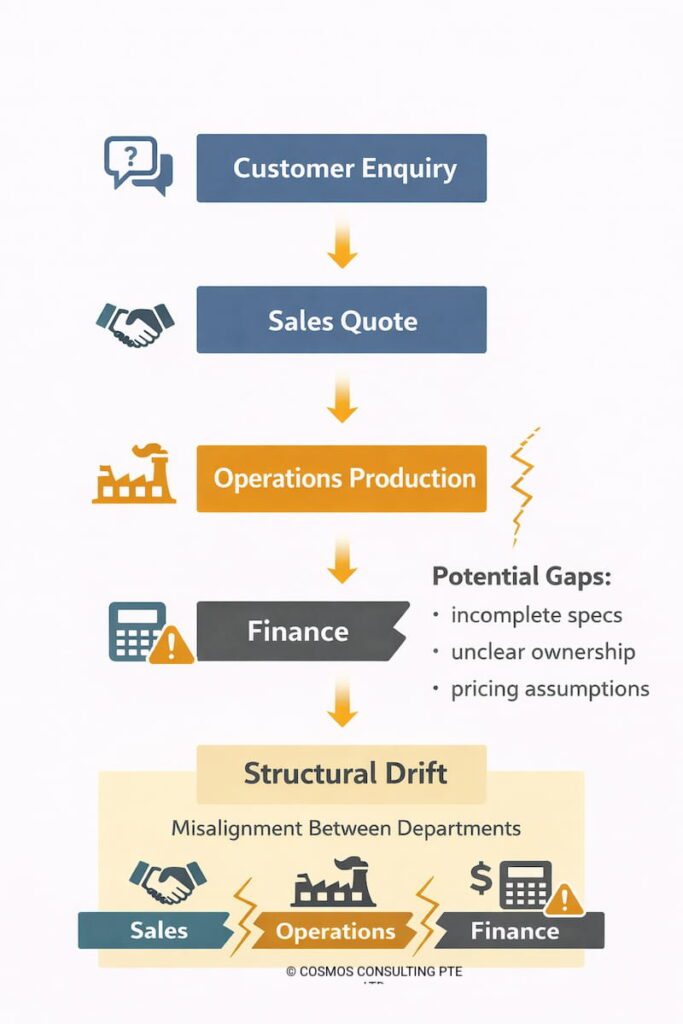
They move between departments.
Where exactly does sales hand off to operations?
What information must be complete before work begins?
Who validates pricing assumptions?
When does finance confirm margin health?
If these handoffs rely on conversations rather than defined workflows, alignment will depend on memory.
And memory does not scale.
This is why SOP clarity must extend across departmental handoffs — not just within teams.
4. No Shared Operational Dashboard
Departments reviewing separate reports is not alignment.
A shared operational dashboard forces shared reality.
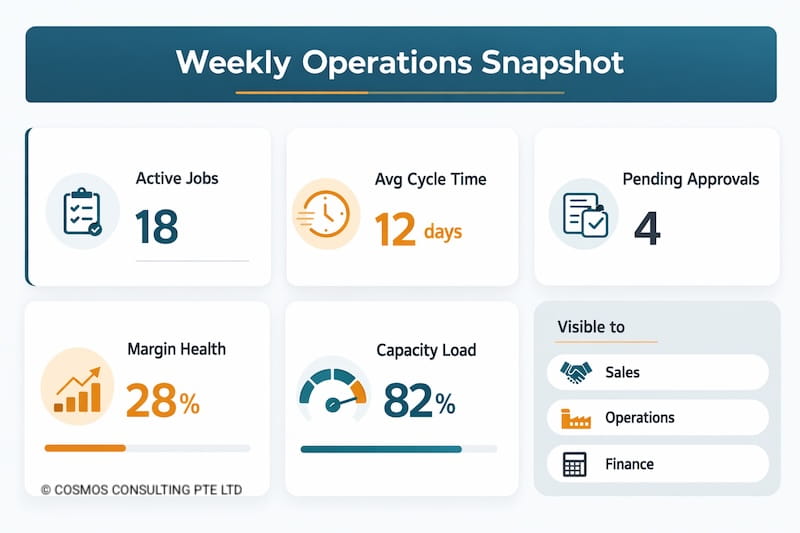
Active jobs. Cycle time. Pending approvals. Margin health. Capacity load.
When these are reviewed weekly across departments, conversations change.
Instead of debating assumptions, teams respond to visible data.
Blame reduces.
Decisions accelerate.
Operational silos shrink when visibility expands.
Structural Solution: Design Before Discussion
When cross-department communication in SMEs weakens, the instinctive response is usually more conversation.
More meetings.
More clarifications.
More escalation.
But alignment rarely improves through discussion alone.
It improves when the structure connecting departments becomes visible.
In well-run SMEs, coordination does not depend on personalities. It depends on a few structural foundations:
• Clear ownership for end-to-end workflows.
• SOP clarity across departmental handoffs.
• Shared operational metrics across teams.
• Visible dashboards reviewed regularly.
These elements reduce interpretation.
Sales understands what operations need before committing to timelines. Operations understands the financial assumptions behind the job. Finance sees the operational reality affecting margin.
Instead of translating between departments, the founder begins observing a system that explains itself.
This is where structural clarity replaces constant alignment.
Inside the COSMOS 4S Systems Framework™, this sits across three layers:
→ Structure defines responsibility.
→ SOPs define execution.
→ Systems create visibility.
When these layers mature together, silos weaken naturally.
Not because departments communicate more.
But because the business now operates on a shared operational picture.
Practical Stabilization Steps
If cross-department gaps are already appearing in your business, the goal is not to redesign everything at once.
Start by stabilizing visibility between functions.
A few structural actions can change coordination surprisingly quickly.
1. Map One End-to-End Workflow
Choose a common workflow; for example, enquiry to delivery.
Write down every departmental handoff.
- Where does sales pass responsibility to operations?
- What information must be complete before work begins?
- When does finance confirm margin assumptions?
Most founders immediately see where interpretation replaces structure.
2. Assign One Owner per Workflow
Ownership should follow the outcome, not the task.
Even when several departments participate, one person must remain responsible for the full flow… from start to finish.
This eliminates the grey zones where gaps usually form.
3. Track a Few Shared Operational Metrics
Instead of reviewing separate departmental numbers, introduce a few metrics that reflect cross-functional reality.
For example:
- Active jobs across teams.
- Cycle time across the workflow.
- Pending approvals between departments.
Shared metrics create a shared operational truth.
4. Replace Verbal Alignment with Visible Commitments
If a commitment affects another department, it should exist somewhere visible.
Not only in conversation.
When commitments become visible, coordination improves automatically.
When Growth Outpaces Structure
As SMEs grow, complexity is inevitable.
More clients.
More parallel work.
More specialised teams.
Silos are not signs of failure.
They are signals that the structure connecting departments has not evolved with the business.
When workflows cross departments without clear ownership, shared metrics, and visible handoffs, alignment depends on conversation.
And conversation does not scale…
…Structure does.
If sales, operations, and finance frequently require the founder to “align” situations, the issue is rarely communication.
It is usually “visibility”.
Look closely at where work moves between departments.
Where ownership becomes unclear.
Where information is reinterpreted.
Where decisions slow down.
Those points reveal the real cross-department gaps.
And once those gaps become visible, structural fixes become possible.
Clarity first.
Alignment follows.