

COSMOS FOUNDER DEPENDENCY DIAGNOSTIC MODEL™
Founder Dependency: When Normal Work Still Needs the Founder to Keep Moving.
Founder dependency is the condition in which recurring operational work cannot move reliably without unnecessary founder involvement in execution, routing, decisions, knowledge, exceptions or coordination.
The COSMOS Founder Dependency Diagnostic Model™ helps identify where that dependency is sitting and what must move so the business has another reliable path to follow.
The work may move. The dependency may not.
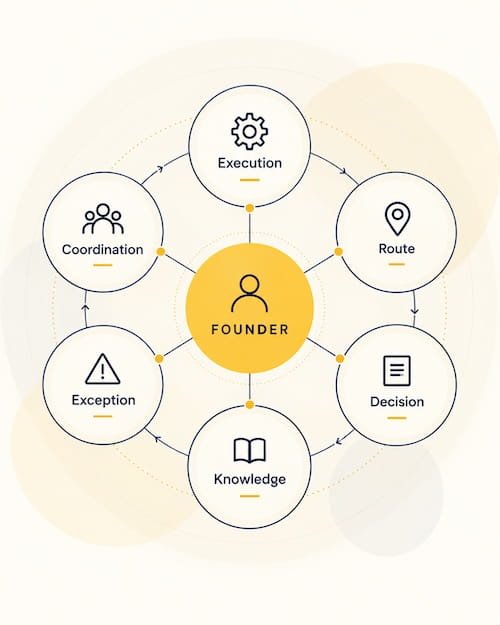
WHY DOES IT STILL COME BACK TO YOU?
You may have delegated the work.
The dependency may still be there.
You may already have done many of the things growing founders are told to do.
Hired more people.
Delegated more work.
Added managers.
Documented processes.
And yet, somehow, normal work still finds its way back to you..

A customer calls you
Even though someone else owns the account.

A manager waits for your judgment
Before making a routine decision.

Someone needs information only you remember
Even though they now own the work.

One department changes something
And you are still the person connecting everyone else.
None of these moments looks serious on its own. Together, they reveal something bigger:
the business still needs your presence to keep normal work moving.
The work may have moved. The dependency may not.
WHAT FOUNDER DEPENDENCY ACTUALLY MEANS
Founder dependency is not the
same as founder involvement.

Founder dependency is the condition in which recurring operational work cannot move reliably without unnecessary founder involvement in execution, routing, decisions, knowledge, exceptions or coordination.
The founder may still be deliberately involved in work that genuinely requires founder-level judgment.
The problem begins when normal operational work requires the founder simply because the business has not yet created another reliable path.

FOUNDER INVOLVEMENT
Can be intentional and
valuable.
- Strategic direction
- Major commitments
- Critical risks
- Founder-level judgement

FOUNDER DEPENDENCY
Normal work still needs you
to keep moving.
- Routine approvals
- Founder-held context
- Recurring exceptions
- Founder routing/ coordination

WHY DELEGATION ALONE DOES NOT SOLVE IT
The task may have moved to someone else.
But if authority, context, exception boundaries or visibility did not move with it, the founder can remain part of the operating path. That is why founder dependency can survive hiring, delegation, management layers, software and documentation processes.

The task may move. The operating conditions around it may not.
Founder involvement is not the problem. Unnecessary founder dependence is.
LAYER 1 – DIAGNOSE
The Six Founder Dependencies.
“Everything comes back to me” is rarely one problem.
Founder dependency usually appears in six distinct ways.

01
Execution Dependency
What still needs me to do it?
Recurring work still needs your personal execution.

02
Route Dependency
Who still comes through me?
People still use you as the default route.

03
Decision Dependency
What still waits for my decision?
Routine work still waits for your judgment or approval.

04
Knowledge Dependency
What still needs what I know?
Work still depends on context or knowledge held by you.

05
Exception Dependency
What still comes back when reality changes?
Deviations still return to you before work can continue.

06
Coordination Dependency
What still needs me to connect the pieces?
You still connect teams, information or priorities.
The question is not how involved you are.
It is what the business still needs you for in order to keep moving.
THE QUESTION THAT COMES NEXT
Should this genuinely
require the founder?
Finding a dependency does not automatically mean it should be removed.
Some work belongs at founder level because it carries strategic judgment, material risk or
decisions that genuinely shape tine direction of the business.
The question is whether the founder is involved by design – or because the operating system has no reliable alternative.
01
IDENTIFY
What still requires me?
02
EXPLAIN
Why does it require me?
03
CHALLENGE
Should it require me?
Should it require me?
YES
Keep it at founder level intentionally.
Founder-level work may include: strategic direction, major commitments, critical risks and decisions that genuinely require founder judgment.
NO
Redesign the operating path.
Move the ownership, authority, context and boundaries required for normal work to continue without unnecessary founder involvement.
PROTECT CONTROL
Define what remains visible, which exceptions should escalate and how performance will be reviewed.

Founder involvement is not the problem.
Unnecessary founder dependency is.
LAYER 2 – REDESIGN
You cannot transfer only the task.
A handover is only complete when the operating conditions around the work move too.
If one of these conditions is missing, the work can easily find its way back to the founder.
01
OWNERSHIP
Who is accountable for the outcome?
A specific person or role owns the result – not just the activity.
02
AUTHORITY
Can they make the routine decisions?
The owner has enough permission to keep normal work moving without repeatedly seeking founder approval.
03
CONTEXT
Do they have what they need to act well?
They can access the information, history, standards and operating knowledge required to make sound decisions.
04
EXCEPTION BOUNDARIES
Do they know what to handle — and what to escalate?
They understand where their authority ends and which situations genuinely require escalation.
05
VISIBILITY
Can the business see what is happening without the founder stepping back in?
Progress, deviations and outcomes are visible without constant founder chasing.
A complete handover requires ownership, authority, context, exception boundaries and visibility to move with the work.
The work may move. The dependency should move with it.
LAYER 3 – BUILD
Create the operating path through 4S.
Once a dependency has been identified and the handover conditions are clear,
the business needs an operating structure that can support the new path.
This is where the COSMOS 4S Systems Framework™ comes in.
S1
Structure
Clarify who owns what.
Define ownership, roles, decision rights and accountability so work does not automatically fall back to the founder.
S2
SOPs
Make recurring work explicit.
Capture the standards, steps and context people need so the business does not rely on repeated founder explanation.

S3
Systems
Make work visible and connected.
Create reliable handoffs, information flow and visibility so progress does not depend on founder chasing.

S4
Scale
Make the new path hold as the business grows.
Build enough capacity and resilience so increased volume and complexity do not recreate founder dependency.
4S builds the system the founder was previously carrying personally.
4S builds the path.
LAYER 4 — SUSTAIN
Keep the new path from drifting back.
A new operating path can be designed well and still weaken over time.
People fall back into old habits. Decisions start moving upward again. Context stops being recorded. Ownership blurs. The COSMOS 5R Leadership Framework™ helps keep the new operating path visible, owned and reinforced.

R1
REVIEW
Check whether the new path is holding.
See whether work, decisions and outcomes are moving as intended without constant founder participation.

R2
RECORD
Keep important context visible.
Capture decisions, standards, changes and operating knowledge so the business does not fall back on founder memory.

R3
REASSIGN
Keep ownership with the right person.
Move responsibility deliberately when roles change or when ownership is sitting in the wrong place.

R4
REPORT
Move the right information upward.
Surface the risks, exceptions and performance information that genuinely need attention — without routing everything to the founder.

R5
REINFORCE
Make the new behaviour normal.
Repeat and strengthen the operating habits until people stop automatically returning to old founder-dependent ways of working.
THE COMPLETE PATH
Diagnose → Redesign → Build → Sustain
Founder dependency is rarely solved by one action.
Each layer answers a different question – and together they create a path from recognising the dependency to building an operating system that can hold without unnecessary founder involvement.
DIAGNOSE
Where is the founder still embedded?
6
FOUNDER
DEPENDENCIES
Identify what normal work still needs from you.
REDESIGN
What has not moved with the work?
5
HANDOVER CONDITIONS
Define what must transfer so the dependency does not return.
BUILD
What operating structure is needed?
4S
SYSTEMS
FRAMEWORK™
Build the ownership, workflows, systems and capacity that support the new path.
SUSTAIN
How do we stop the business drifting back?
5R
LEADERSHIP
FRAMEWORK™
Keep ownership, decisions, visibility and operating behaviour reinforced.
6 Dependencies → 5 Handover Conditions → 4S → 5R
The dependency tells you where the founder is still embedded. The handover conditions tell you what has not moved.
4S tells you what to build. 5R tells you how to keep it working.
START SMALL
Do not try to remove yourself
from everything at once.
Start by noticing where the business still pulls you back in.
For the next week, pay attention every time someone needs you to:
do something
answer something
approve something
explain something
solve an something
connect people
or information
01
NOTICE
What did they need me for?
Do not judge it yet.
Just capture the recurring moments where normal work still requires you.
02
DIAGNOSE
Which dependency is operating?
Execution
Route
Decision
Knowledge
Exception
Coordination
Should this genuinely require founder-level involvement?
03
REDESIGN ONE PATH
What would have to change so this no longer requires me?
Clearer
ownership
Enough
authority
Accessible
context
Defined
exception
boundaries
Better
visibility
Founder dependency reduces through repeated redesign of small
operating paths – not through one large act of delegation.

GO DEEPER
Why does everything still come back to you?
Founder dependency often survives hiring, delegation, managers and documented processes because the work may have moved — while the operating dependency has not.
In this COSMOS Deep Dive, I walk through the six hidden forms of founder dependency and show why delegation alone does not remove them.
WHAT COMES NEXT
The goal is not to remove the founder.
It is to build another reliable path.
Founder dependency reduces when normal work no longer needs your presence simply to keep moving.
That means transferring more than tasks. It means building enough ownership, authority, context, exception boundaries and visibility for capable people to move work forward – while the founder retains the decisions that geniunely require founder-level judgment.
Work stops coming back to the founder when the business has another reliable path to follow.
Have a specific operating problem? Work with CJ →