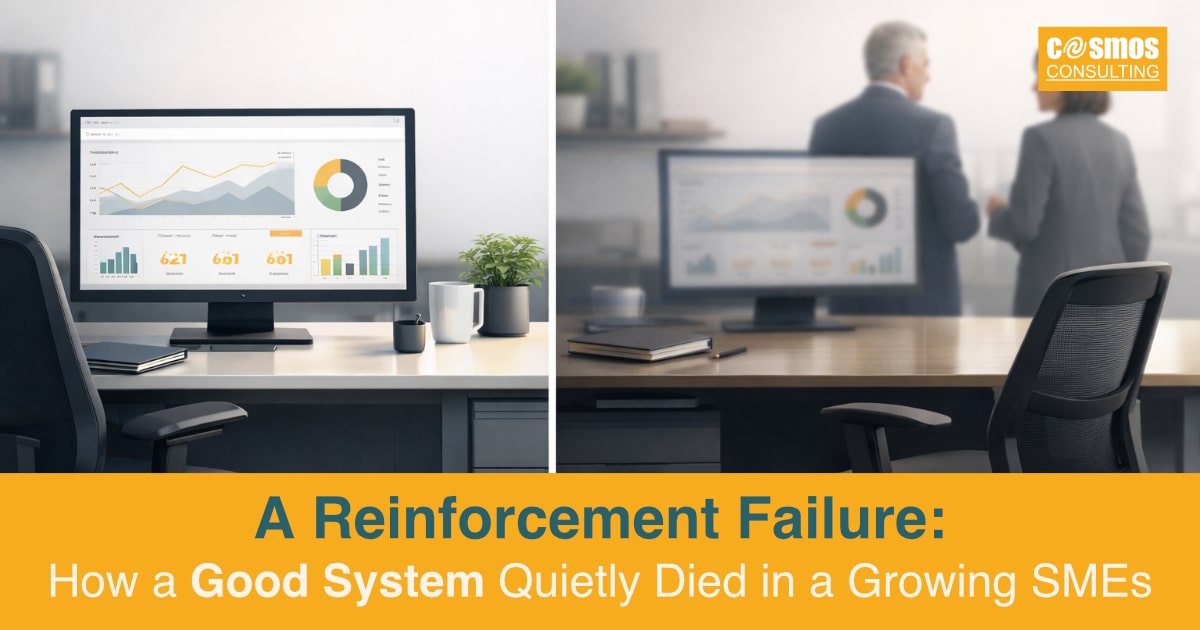
The System worked… Until it didn’t.
The system was not broken.
In leadership terms, this is a classic case of reinforcement failure in SMEs, where systems fade not because they were wrong, but because leadership attention moved on.
In fact, it worked exactly as designed.
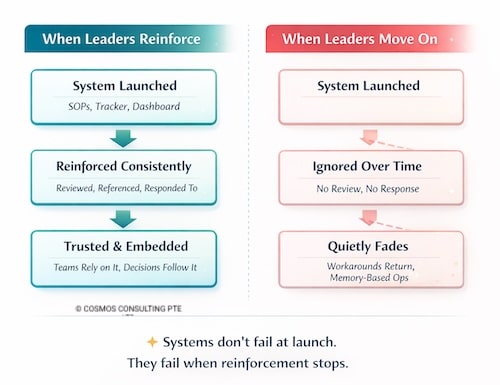
The SOPs were clear. The tracker was simple. The dashboard surfaced the right signals at the right time. For a while, things genuinely improved – fewer follow‑ups, fewer surprises, less firefighting.
Then, without any formal decision, the system began to lose its grip.
There was no dramatic failure. No announcement. No resistance.
Just silence…
What changed was not the System; it was Leadership Attention
In the early weeks, leaders checked the dashboard regularly.
Deviations were discussed. Patterns were noticed. Small adjustments were made.
Then priorities shifted.
Reviews were postponed. Conversations slipped back to WhatsApp. Meetings focused on outcomes, not signals. The tracker was still filled, but no longer referenced.
Nothing was said explicitly…
…That absence of response is what weakened the system.
When Signals Stop Mattering, Behaviour Follows
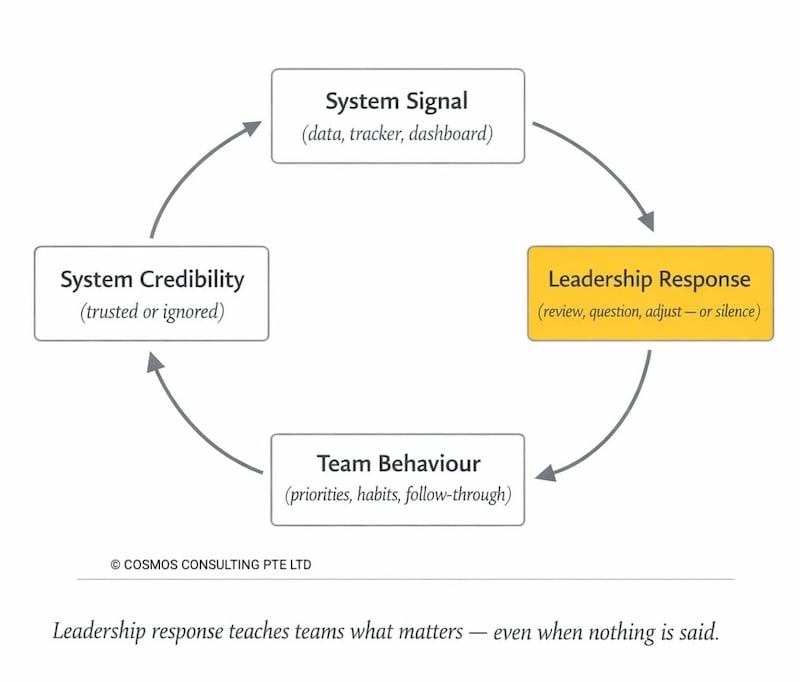
Teams are remarkably good at reading leadership behaviour.
They don’t wait for instructions. They observe patterns.
In this case, when system signals stopped triggering leadership responses, the message was unmistakable:
This system is optional.
Not immediately. Not consciously.
But gradually.
Updates became delayed. Exceptions became routine. Workarounds quietly returned.
On paper, the system still existed. In practice, it had lost authority.
The Quiet Cost of Non-reinforcement
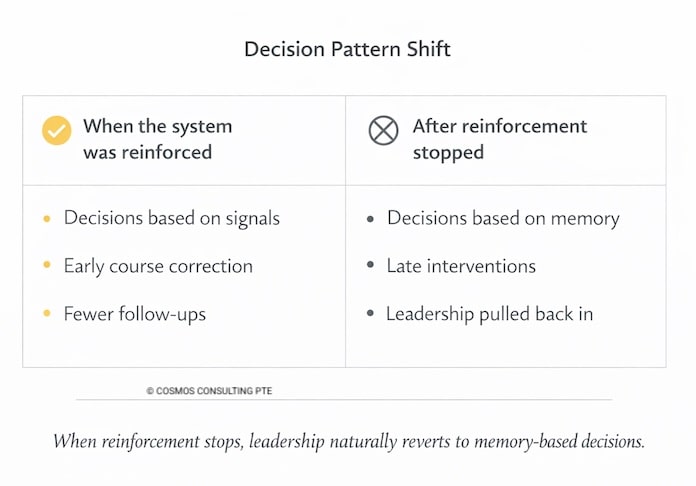
Nothing collapsed overnight.
But over the next few months:
- Small delays reappeared
- Ownership blurred again
- Leaders found themselves pulled back into follow‑ups
- Decisions leaned more on memory than data
Ironically, the system was blamed.
“It worked initially, but it didn’t sustain.”
The truth was simpler.
The system had not failed.
It had stopped being reinforced.
🟡See COSMOS Case Library on Youtube
If these operating patterns feel familiar, then you can explore the COSMOS Case Library, where we investigate the everyday SME breakdowns and reveal the hidden system gap behind them.
Reinforcement is Not Control – it is Consistency
This is where many leaders hesitate, and it is exactly what happened here.
They don’t want to micromanage.
They don’t want to hover.
They don’t want to become the bottleneck again.
So they disengage entirely.
But reinforcement is not about checking every task. It is about consistently responding to signals.
When leaders respond only during failures, systems become crisis tools.
When leaders respond regularly, systems become decision infrastructure.
That distinction determines whether a system survives or not.
The Leadership Lesson
Looking back, the failure was not technical.
It was behavioural.
The moment leaders stopped using the system to guide decisions, the team followed.
This pattern is common across growing SMEs, and it is what unfolded in this case as well.
And it is exactly why reinforcement sits at the final step of the COSMOS 5R Leadership Framework™ – not as a task, but as a leadership discipline.
Reinforcement is what turns implementation into a habit.
Is Too Much Work Still Returning to You?
Take the free COSMOS 5R Leadership Self-Check to identify where Review, Record, Reassign, Report or Reinforce needs strengthening.
💡 We use MailerLite to power our lead magnets and client communications. It’s beginner-friendly, powerful, and highly affordable for SMEs
Related Posts
- How the 5R Framework Strengthens SME Leadership Without Burnout or Bottlenecks
- Start With Truth: Why Reviewing Bottlenecks Is Your First Leadership Move
- Don’t Just Delegate—Reassign With Ownership
- Track It to Trust It: The Role of Reporting in Scalable Teams
- Dashboards Don’t Have to Be Ugly – Systems That Make Teams Self-Manage
Final Reflection
For broader insight into why change efforts often falter when leadership attention shifts, see this analysis on organizational change challenges by Harvard Business Review.
Systems don’t fail at launch.
They fail when leadership attention moves on.
If a system stops influencing decisions when no one is watching, it was never reinforced.
And the fix is rarely a new tool.
It is a return to consistent leadership response: calmly, predictably, and visibly.
Get 5R Checklist & More
Download this and other free templates from the
COSMOS Resources Vault.
SOP Starter Kit • 4S Checklist • 5R Checklist • Dual Framework Guide • Ready Reckoners